Giant Game Boy
By Andrew Gregory. Posted
This article was originally published as part of HackSpace magazine, which has since been incorporated into Raspberry Pi Official Magazine.
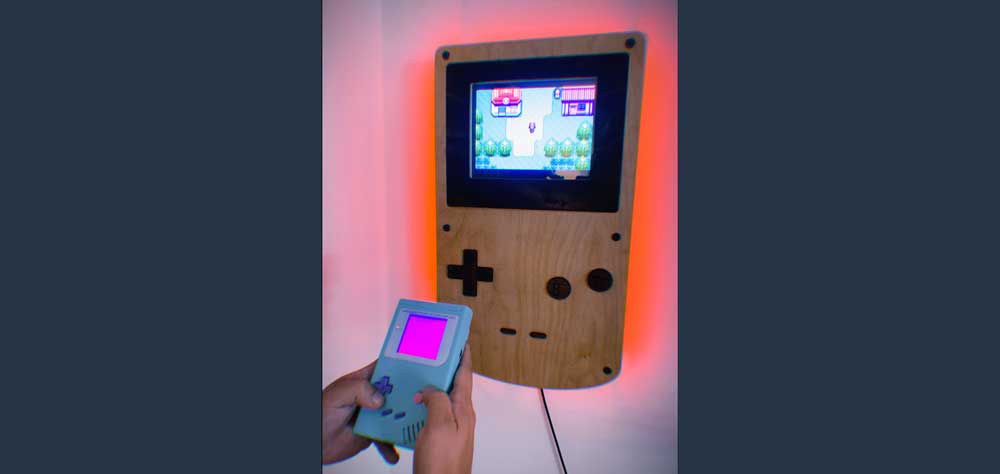
Growing up in Chicago, Willie Colón, was always on the go with a Game Boy Color, so Willie decided to take that iconic shape and build what is the Game Boy XL.
"I made the initial designs on Illustrator, and from there I made the front and back plates of the Game Boy," says Willie. "I took my designs to a CNC router, got them cut out, then sanded, and finally, I stained them by hand. I used a cheap TV monitor with an HDMI to connect the Raspberry Pi, and used arcade buttons for the controls on the front plate to make it functional."
"Thanks to the help of my good friend Isaac Gelman (another amazing maker), I was able to get some help on the finer details by laser cutting the D-pad and buttons. The reason I built a giant Game Boy was to see if I could do it!"
"There was a gamer-centric gallery happening where I work at Nickelodeon, and I was trying to figure out if it would be possible to take on such an ambitious project. I have also always been passionate about the original DMG, so it was a perfect fit."
"It is currently hanging in my living room for everyone to see and play, but when I’m home alone, I use a special Bluetooth Game Boy cartridge, and put it into one of my self-modded Game Boys to control the XL. I love gaming! Video games have always, and will continue to be a huge part of my life.

Features Editor Andrew trawls the internet for Cool Stuff while keeping the magazine running smoothly.
Subscribe to Raspberry Pi Official Magazine
Save up to 37% off the cover price and get a FREE Raspberry Pi Pico 2 W with a subscription to Raspberry Pi Official Magazine.
More articles
Make a Smart Home in Raspberry Pi Official Magazine issue 167
The dream of smart, connected devices controlling your home automatically, is especialy appealing on a lazy day when we’re trying to get work done in a heatwave. Maybe this will be the year we finally integrate temperature sensors with fans and a drinks dispenser to keep us cool, or maybe not, but we do know […]
Read more →
Win 1 of 3 Pironman 5 Pro Max cases!
Transform your Raspberry Pi with this amazing case
Read more →

Learning to code in an AI age
A new Raspberry Pi Foundation course helps young people learn to code.
Read more →