The Sense HAT touches down
By Russell Barnes. Posted

Soon to be seen in low Earth orbit, you can now own the space-bound Sense HAT add-on board that makes the Astro Pi project possible

Take back control of your online data, with Raspberry Pi.
The Sense HAT is out and hopefully you’ve managed to get your hands on one, but if you’re still unsure as to what it even is, you may at the very least be familiar with the project it’s attached to: Astro Pi.
The Sense HAT is the add-on board holding the key sensors that enables Astro Pi to exist in the first place, and will be attached to a selection of Raspberry Pis as they head up to the International Space Station at the end of 2015. The Sense HAT had slightly more humble beginnings, though, at least according to project lead Jonathan Bell:
“I kinda hijacked a pet project of James [Adams’s] and turned it into a space-faring board,” he reveals. James Adams is the director of hardware at Raspberry Pi, and he and Jonathan were the main forces behind the Sense HAT.

“Effectively we wanted to produce a HAT that would be a neat, fun example of how to design a HAT,” Jonathan continues, telling us the simple origins of the Sense HAT. “It was an exercise in how to design a HAT that can be put into mass-production: how would somebody go about doing that so hundreds of thousands of HATS could be produced, and how would we design the board to deal with that.”
Halfway through development, what was once a relatively basic HAT received a whole host of ST microsensors, the same kind used on mobile phones. “Eventually we said, hang on a minute: what happens if we put loads of sensors on this thing and turn it into a kind of a cool toy!”
The Sense HAT was eventually completed with three key sensor chips: separate pressure and humidity chips that can also both measure temperature at different levels of sensitivity, and a positional chip that contains an accelerometer, a gyroscope, and a magnetometer. There’s also an 8×8 LED display and a tiny little joystick that you can use in conjunction with the sensors or completely on their own.
All of this is accessible on the Raspberry Pi by just popping the HAT on the GPIO ports and getting the special Python library for it, which is what the space-bound Pis will be using when they get sent off-world.

“The Astro Pi experiments make good use of the HAT itself,” Jonathan tells us, “some of them in quite unusual ways. We have a few Easter eggs up there, which you’ll have to find out about, but there have been some ingenious uses of the sensors. One of the experiments that caught our eye in terms of sensing was one that attempted to detect an astronaut. The astronaut detector sits there, monitoring the humidity, and if there is a certain percentage change in humidity in the module, it thinks there’s an astronaut present. It flashes a message on the LED matrix saying ‘are you there?’.
“Can we detect a human presence in a ventilated module? And the answer is, yes you can; humidity is monitored on the ISS already and hopefully we’ll be surprised that the experiment has a good result. Anyway, once it says ‘are you there?’, it will then ask you to take a picture. Press a button, go around the other side of the Astro Pi, and smile for the camera. So, through that experiment, they’re trying to track if they can get a variation of humidity, and if that variation is also correlated with the presence of an astronaut in the module. That’s two good experiment objectives right there.”
There are many more experiments where that came from, all of which we’ll start seeing reports from in early 2016. As for now, though, if you want to do your own experiments Earth-side, Sense HATs are available from the Swag Store.

Russell runs Raspberry Pi Press, which includes The MagPi, Hello World, HackSpace magazine, and book projects. He’s a massive sci-fi bore.
Subscribe to Raspberry Pi Official Magazine
Save up to 37% off the cover price and get a FREE Raspberry Pi Pico 2 W with a subscription to Raspberry Pi Official Magazine.
More articles

Take Back Your Clound in Raspberry Pi Official Magazine 165
We’re all-too accustomed to the feling of being watched on the internet. A search for any product leads to adverts, emails, and goodness knows how many bots tracking you. It feels weird and intrusive, and we aren’t being paranoid – they really are watching us. Luckily you don’t have to reply on online services that […]
Read more →
Win one of three Raspberry Pi 4 with 3GB RAM!
Raspberry Pi 4 is still a powerful piece of kit, and this new 3GB version is great for projects and builds that need slightly more than 2GB of RAM but don’t quite need 4GB. We have three to give away and you can enter below. Win 1 of 3 Raspberry Pi 4 3GB
Read more →
Etch A Sketch CNC machine
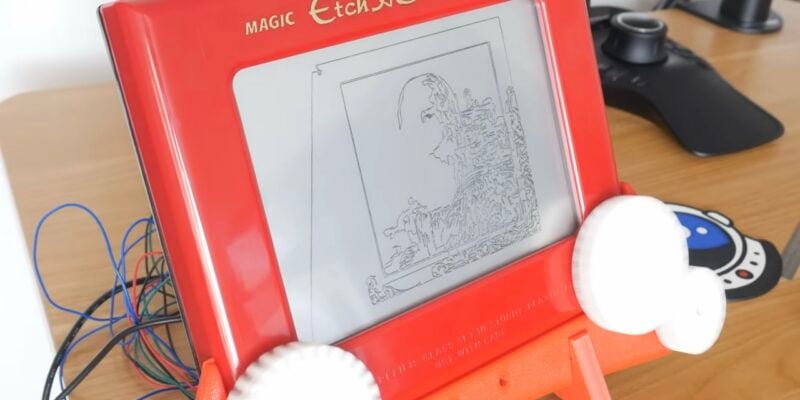
The software controlling the Etch A Sketch logs the image, turns it into vectors, turns the vectors into G-code, then sends the G-code to the Etch A Sketch – and it was all written by AI
Read more →