Sean’s Robot
By Rob Zwetsloot. Posted

Edge detecting, face detecting, and voice-controlled – this happy robot can do it all.
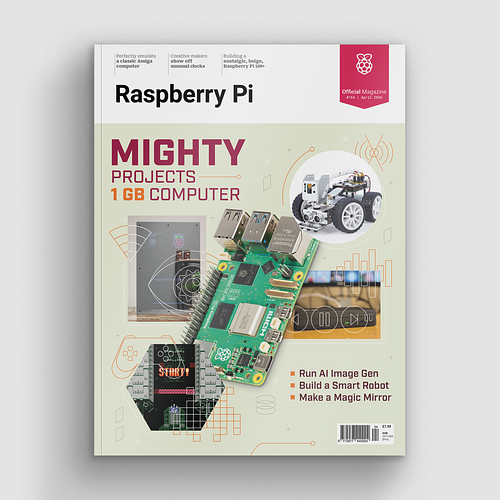
Robots with faces don’t always work, we find. Sometimes they can be just creepy. Sean Glendinning’s robot is a bit different, though, in that it’s kinda cute. Which is great, as due to its face-sensing capabilities it will sometimes look at you.
This article first appeared in The MagPi 81 and was written by Rob Zwetsloot
“For my Gold CREST Award project, I decided to design and build a robot powered by the Raspberry Pi computer system,” Sean tells us. “The robot is able to detect edges, faces, and some voice commands. It moves around on caterpillar tracks and if it detects a face, it reacts by tilting its head.”
CREST is a scheme to get young folks into STEAM subjects by contributing something much more real and practical than you would at school. Apparently, a gold award project can take more than 70 hours to complete.
“This was a challenging build, but it was really fun and I learned a lot,” Sean continues. “I designed the 3D-printed chassis myself, using skills I learned in graphic design at school. I had quite a lot of the required electronic components already, and I tried to improvise where I could to keep costs down. There are some special components, though, like a USB microphone and the 3D-printed chassis, that I had to buy online. I tried to make the robot have a friendly design and personality, and able to move around without bumping into things.”

From arms to tracks
Sean has been building robots for years, albeit much simpler robot arms – the kind you see in factories building cars, or as Pi kits like MeArm Pi and PiArm.
“The first one I built in 2015, was made of plywood and held together with glue,” Sean recalls. “The second one was made of laser-cut acrylic plastic. Neither of these arms actually worked, as they were both quite badly designed. The third arm was built in 2018, and I spent three months designing it. It was made of thick plywood and aluminium braces, which held together a lot better than the other two arms.”
After being inspired by a toy robot, Sean decided to build a more mobile kind of robot using a Raspberry Pi.
“I have used the Raspberry Pi for a number of projects, and knew that an Arduino wouldn’t be powerful enough for speech or face recognition,” he reveals. “For its size and cost, the Raspberry Pi has a powerful processor and was able to handle the complicated speech and face detection libraries.”
The robot uses IR distance sensors arranged around the chassis for its edge/wall detecting, along with a Raspberry Pi Camera Module for face detection, all housed within its own 3D-printed case. We think it’s a great build, and look forward to seeing what robots Sean makes in the future.


Rob is amazing. He’s also the Features Editor of Raspberry Pi Official Magazine, a hobbyist maker, cosplayer, comic book writer, and extremely modest.
Subscribe to Raspberry Pi Official Magazine
Save up to 37% off the cover price and get a FREE Raspberry Pi Pico 2 W with a subscription to Raspberry Pi Official Magazine.
More articles
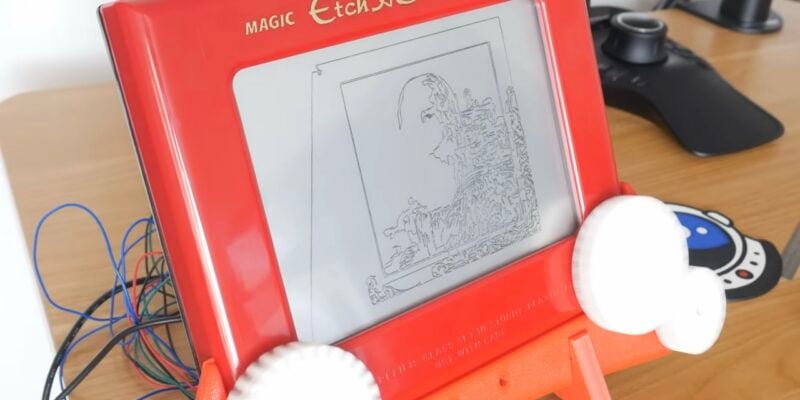
Etch A Sketch CNC machine
The software controlling the Etch A Sketch logs the image, turns it into vectors, turns the vectors into G-code, then sends the G-code to the Etch A Sketch – and it was all written by AI
Read more →

Vintage Radio Plex Server
There’s an antenna sticking up on this build, but it’s just for show
Read more →
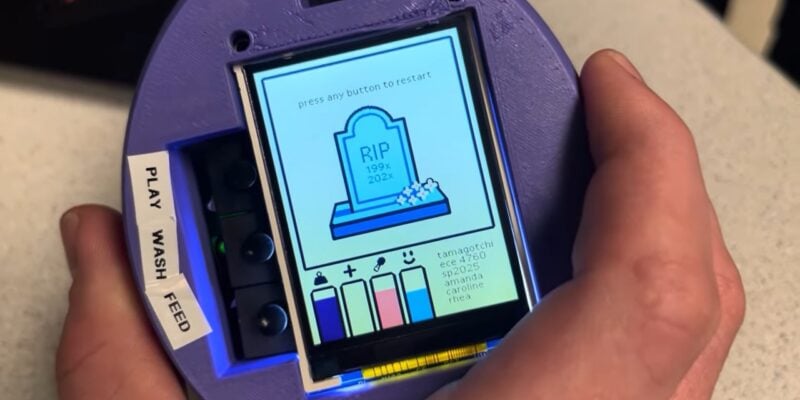
Cyber Pet Tumbler
This virtual pet can be thrown around its plastic case. Rob Zwetsloot tries to keep it alive
Read more →