Use a robot to build a robot
By Andrew Gregory. Posted
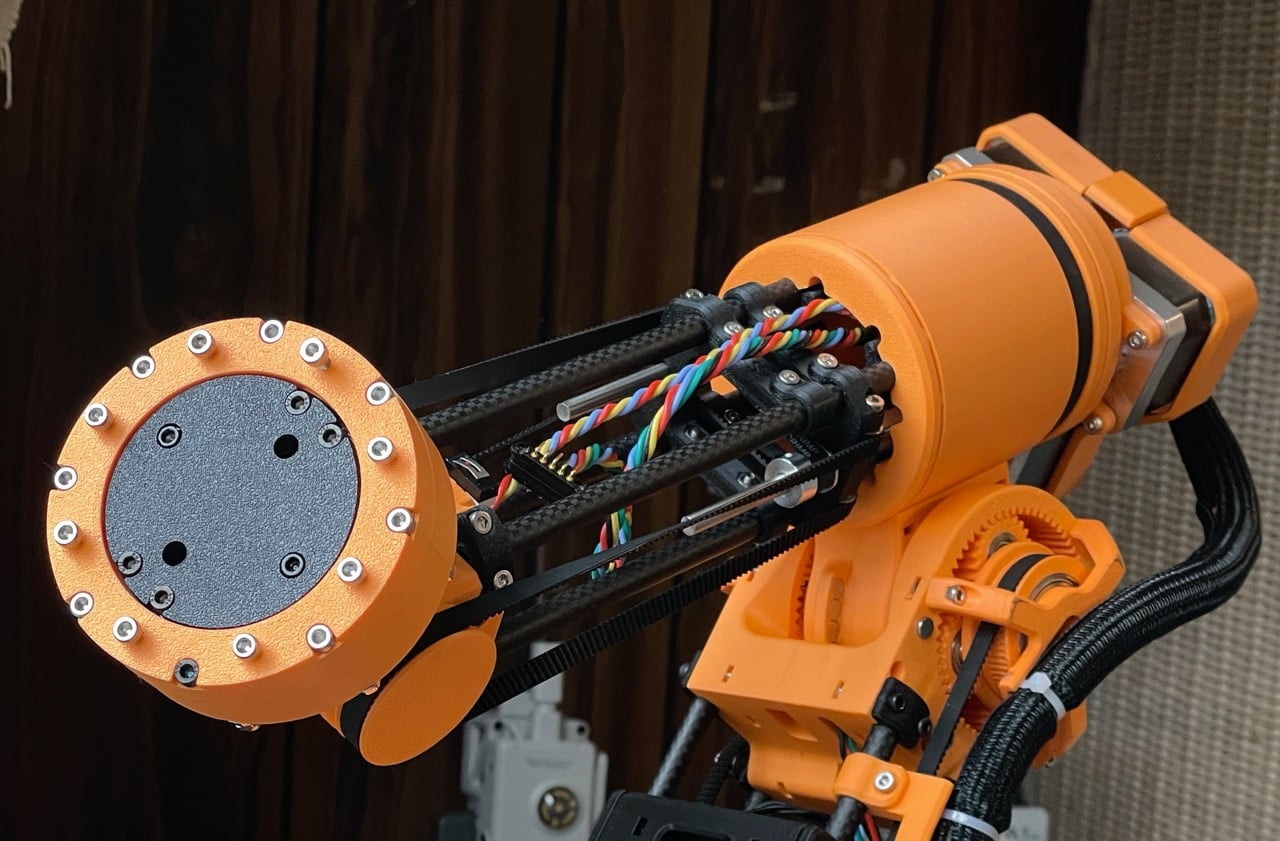
Imagine you’re an engineering student, using ROS (the Robot Operating System) to learn about robotics. At some point you’re going to want to break free of the screen and the keyboard and start applying the knowledge you’ve learned to real hardware. That’s what James Gullberg has done with this glorious, (mostly) 3D printed robot with six degrees of freedom.
The joints and the gears are all 3D printed and are connected by carbon-fibre tubes. This enables James to quickly iterate on the design of each joint without having to reprint the whole arm each time he makes a change. The modular construction and the fact that it’s 3D printed offer the opportunity for lots of experimentation: the shoulder and elbow joints use split-ring planetary gearboxes, while the wrist joint uses an inverted belt differential. To sense the position of the joints, there are embedded magnets monitored by a magnetic encoder.
In this robot build, James has used a Raspberry Pi as a CAN bus. The ‘CAN’ stands for ‘controller area network’. Rather than having all of the discrete devices (such as motors, and sensors on each individual joint) talk to each other directly, they instead talk to one separate device. It’s a way of making intrasystem communication more efficient, reduces wiring, and gives a degree of central control over which messages are prioritised. For example, in a car, the messages coming out of the engine are of a higher priority than the messages coming out of an electric window. With this in mind, it should be no surprise that the CAN bus protocol was first used in the automotive industry, for the Mercedes W140 in 1991.
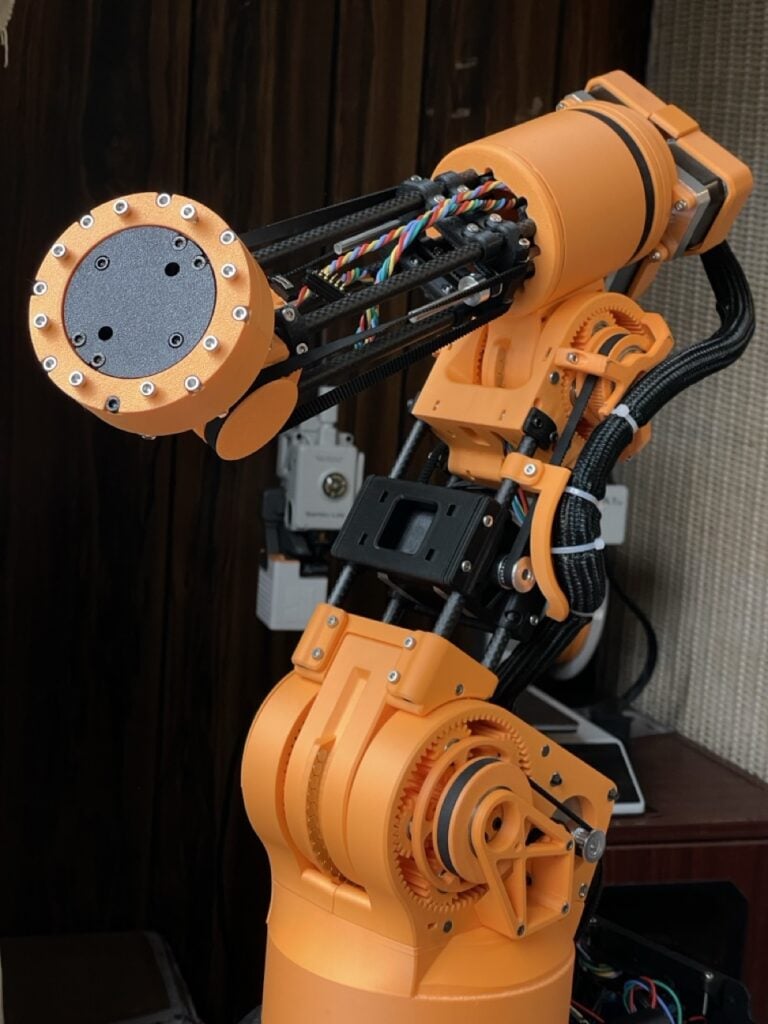
As well as the 3D printed body and gears and carbon-fibre tubes, a lot of the electronics were “salvaged from an old 3D printer” that was about to be thrown out. This brought the cost of the bill down to under $300.

Features Editor Andrew trawls the internet for Cool Stuff while keeping the magazine running smoothly.
Subscribe to Raspberry Pi Official Magazine
Save up to 37% off the cover price and get a FREE Raspberry Pi Pico 2 W with a subscription to Raspberry Pi Official Magazine.
More articles

Make a Smart Home in Raspberry Pi Official Magazine issue 167
The dream of smart, connected devices controlling your home automatically, is especialy appealing on a lazy day when we’re trying to get work done in a heatwave. Maybe this will be the year we finally integrate temperature sensors with fans and a drinks dispenser to keep us cool, or maybe not, but we do know […]
Read more →

Win 1 of 3 Pironman 5 Pro Max cases!
Transform your Raspberry Pi with this amazing case
Read more →

Learning to code in an AI age
A new Raspberry Pi Foundation course helps young people learn to code.
Read more →