Wide Input SHIM review
By Rob Zwetsloot. Posted

We look at expanding power supply options with this dinky board
The Wide Input SHIM from Pimoroni is a handy board that widens the range of power sources you can use with a Raspberry Pi.
The bare Raspberry Pi board is very particular about its power source. It likes a 5.1 V micro USB power supply – the kind commonly used by smartphones.
This article first appeared in The MagPi 69 and was written by Lucy Hattersley
This 5.1 V requirement is enough to power the board, most HATs, and even the occasional servo. But what if you want to integrate the Raspberry Pi within a larger project with different voltage requirements?
That’s where the Wide Input SHIM steps in. With it you can use a range of power supplies, from 3–16 V. These are converted by the small board to 5 V with 2 A output thanks to a TPS63070 buck-boost converter chip.
Measuring just 45×17×6 mm (L×W×H), the SHIM tucks neatly into the corner of the Raspberry Pi board and takes up the first 12 of the 20 GPIO pins. It’s also super-skinny, at just 0.8 mm thick.
Connection options
You can solder the board to the supplied female header and pop it to the end of the GPIO pins. Or, if you’re feeling adventurous, you can solder the board directly to the GPIO pins on your Raspberry Pi. It’s not a soldering project for the faint of heart (or wobbly of hand).
The board features a 3.5 mm barrel jack connector, and included in the package is a 5.5 mm adapter cable. There are additional + and – pins on the SHIM so you can wire up power directly. Or you can use the 3.5 mm to connect black and red tinned wires to integrate the SHIM with your project or hook it up to a bench power supply.
Next to the + and – pins is an EN pin. Pulling this to ground will cut the 5 V voltage output. Be warned though that it won’t perform a clean shutdown. There is also a distinct lack of an on/off button on the board. We would have liked to have seen the button and safe shutdown script from the OnOff SHIM.
Last word
4/5
A perfectly good product that lets you use a wider range of power inputs in your project. It’s fiddly to solder directly onto the board, but the supplied female header makes for an easier solder project. We would have liked an on/off switch, though.

Rob is amazing. He’s also the Features Editor of Raspberry Pi Official Magazine, a hobbyist maker, cosplayer, comic book writer, and extremely modest.
Subscribe to Raspberry Pi Official Magazine
Save up to 37% off the cover price and get a FREE Raspberry Pi Pico 2 W with a subscription to Raspberry Pi Official Magazine.
More articles

Incredible Weather Projects in Raspberry Pi Official Magazine issue 171
If the planet gets too hot/too cold/too drizzly for human habitation, we’ll probably want to leave Earth in search of a better one. That means we’ll need a flight computer, and maker Michael Newton is one step ahead: he’s built a replica of the DSKY (display keyboard) interface from the Apollo Guidance Computer. Now you […]
Read more →

Win one of five Sense HAT bundles
Get a Sense HAT add-on and book in our latest competition
Read more →
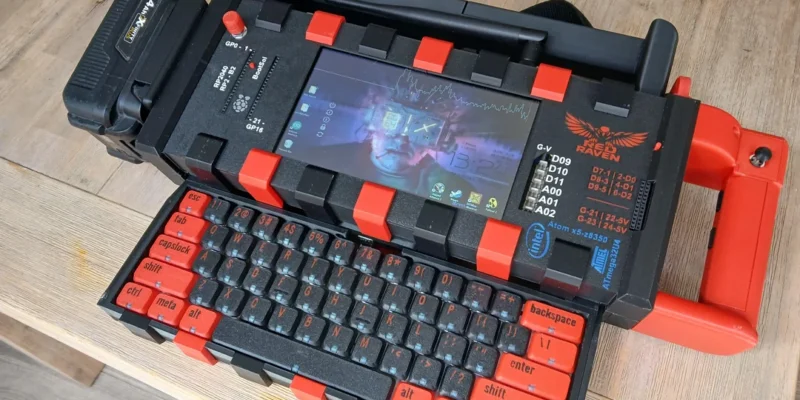
Red Raven cyberdeck
Powered by drills
Read more →