3D Printed Car Parts
By Andrew Gregory. Posted
This article was originally published as part of HackSpace magazine, which has since been incorporated into Raspberry Pi Official Magazine.

Look more closely at this 1962 Volkswagen bus, made by Volkswagen and augmented by Autodesk: the wheel rims, steering wheel, wing mirror
mounts, and other bits are 3D-printed metal. And, rather than being mocked up first in AutoCAD, they’re designed automatically in software in a process called ‘generative design’.
Generative design, like declarative programming, is design worked backwards. Instead of drawing up a plan, then building the project, you start with a set of constraints, and get the software to generate the form that you need.
“In the past, if you’ve designed, let’s say, a vehicle rim, if you’re going to design one of those, in the very far past, you had to basically sketch it by hand”, says Erik Glaser, Principal Product Designer, Volkswagen Group of America. “You had a draughtsman who had to draw the whole thing out – very long process, very tedious.
With generative design, instead of manually designing the actual shape, you give the software constraints. I need it to be this big; I need it to support this much weight in these kinds of directions. You feed it some
physics information, basically.”
Generative design is something that’s only just making its way into mainstream manufacturing, but it’s all around us in nature. That’s why the forms produced here and in other generative designs look so organic. Termite mounds and beehives are great examples of common structures built to a requirement, or if you like to think bigger, H.R. Giger’s designs for the Alien films.
Paul Sohi, Fusion 360 evangelist and iconic projects lead at Autodesk, says of the VW collaboration: “From a design point of view, generative design enables you to create really, really beautiful objects… On top of that, nature is the best designer, and we end up with parts that look a lot like biomimicry. So we know that we’re able to produce something that’s beautiful and is not going to compromise the performance, either.”
“If you speak to any designer or engineer, they’ll tell you that producing
stuff in the real world always takes longer than you think. One of the great things about using generative design here is we were able to go from ideas in our head to a fully manufactured vehicle in about six months, which is unprecedented and unheard of. Being able to do that while maintaining design and engineering is incredible, and it enables us to produce something that’s really quite beautiful to look at.”
More information is available here.
Image Courtesy of Volkswagen

Features Editor Andrew trawls the internet for Cool Stuff while keeping the magazine running smoothly.
Subscribe to Raspberry Pi Official Magazine
Save up to 37% off the cover price and get a FREE Raspberry Pi Pico 2 W with a subscription to Raspberry Pi Official Magazine.
More articles
Incredible Weather Projects in Raspberry Pi Official Magazine issue 171
If the planet gets too hot/too cold/too drizzly for human habitation, we’ll probably want to leave Earth in search of a better one. That means we’ll need a flight computer, and maker Michael Newton is one step ahead: he’s built a replica of the DSKY (display keyboard) interface from the Apollo Guidance Computer. Now you […]
Read more →
Win one of five Sense HAT bundles
Get a Sense HAT add-on and book in our latest competition
Read more →
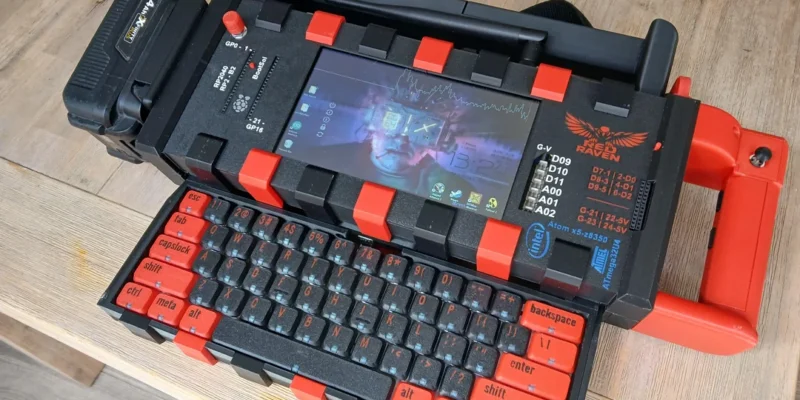
Red Raven cyberdeck
Powered by drills
Read more →