Becca Cam Raspberry Pi SLR camera
By Rosemary Hattersley. Posted

Videographer Becca Farsace knew her way around cameras, but had never used a Raspberry Pi before deciding to build the Becca Cam, an SLR based around one. She didn’t let lack of experience deter her, preferring to learn the necessary skills as she went.

Becca describes herself as “mostly just a tech nerd that lives in Brooklyn, NY.” She approached her first ever Raspberry Pi project with “absolutely zero background in computer science”, but she heard about Raspberry Pi’s High Quality Camera because she reports on camera launches for work. When New York City went into lockdown, she was tasked with creating camera content without being able to go anywhere and capture the world. “That’s when my inner Victor Frankenstein was born,” she says. “What if I built a camera instead of reporting on everyone else'?” She had several film cameras but “no desire to pay to run film through them”. Instead, Becca pondered whether she could retrofit one with a digital camera and use it without the film developing cost. Handily, Raspberry Pi Foundation had sent her a High Quality Camera to review. “Thank y’all so much!” she says, explaining how Becca Cam came to contain a Raspberry Pi 4.
Learning by doing
Becca began with an old toy camera, C-mount lenses, a Raspberry Pi 4, and a Raspberry Pi High Quality Camera module. “The goal was to use the camera hardware as a case and as optics, but hide Raspberry Pi and the camera module inside of it”, she says.

With no programming experience, Becca relied on code she found at the Raspberry Pi Camera Guild and several forums for guidance. “Lack of knowledge was the largest limitation to me. I am a tactile learner with mild dyslexia, so thinking in numbers and letters was not always an enjoyable experience,” she explains. Nonetheless, she persevered, taking her time whenever she had to enter code, and paying close attention to a similar project by Nick Poole from SparkFun. “Originally I thought I could create a digital button to trigger my capture, on a 4-inch touchscreen. When that wasn’t working, I remembered that Nick had used a microswitch as a trigger and decided to go that route as well,” she says.
Build better, Bec
Becca details the process of building her eponymous camera on YouTube. She started with the software, to make sure she could get the camera to take photos. She then put Raspberry Pi 4 into the camera body, before going out and about using it so she could troubleshoot any issues that arose. “Wow, it sounds so straightforward when you type it like that, but there were hiccups at almost every step,” she observes.

If you’re thinking of your own Raspberry Pi project, Becca advises: “The best lesson I learned was find someone who knows a bit more than you so when you are falling on your face, they can swoop in and save you!” She already plans to take her own advice. New York’s transit authority released an API for its trains a while back. “When I am feeling up to another Raspberry Pi project, I would really like to make a train time display for my local train that I could put by my door. That way I would know the perfect time to leave the house!”

Rosie has worked for consumer tech titles such as PC Advisor, Computeractive, CNET and Macworld and written For Dummies books on using iPads, Androids and tablets
Subscribe to Raspberry Pi Official Magazine
Save up to 37% off the cover price and get a FREE Raspberry Pi Pico 2 W with a subscription to Raspberry Pi Official Magazine.
More articles

Incredible Weather Projects in Raspberry Pi Official Magazine issue 171
If the planet gets too hot/too cold/too drizzly for human habitation, we’ll probably want to leave Earth in search of a better one. That means we’ll need a flight computer, and maker Michael Newton is one step ahead: he’s built a replica of the DSKY (display keyboard) interface from the Apollo Guidance Computer. Now you […]
Read more →

Win one of five Sense HAT bundles
Get a Sense HAT add-on and book in our latest competition
Read more →
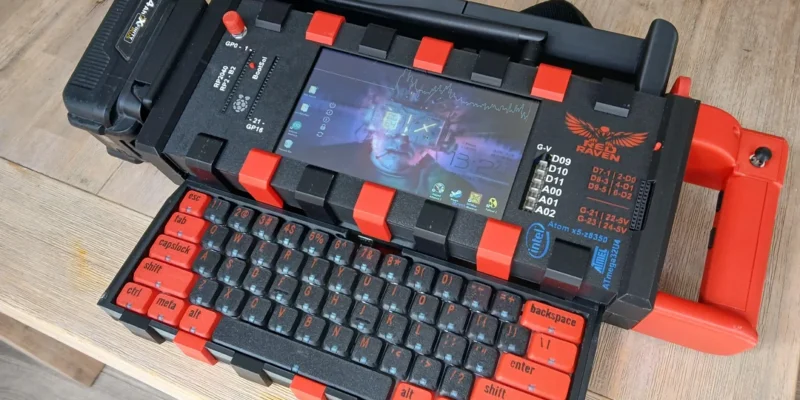
Red Raven cyberdeck
Powered by drills
Read more →