Claw stand
By Andrew Gregory. Posted
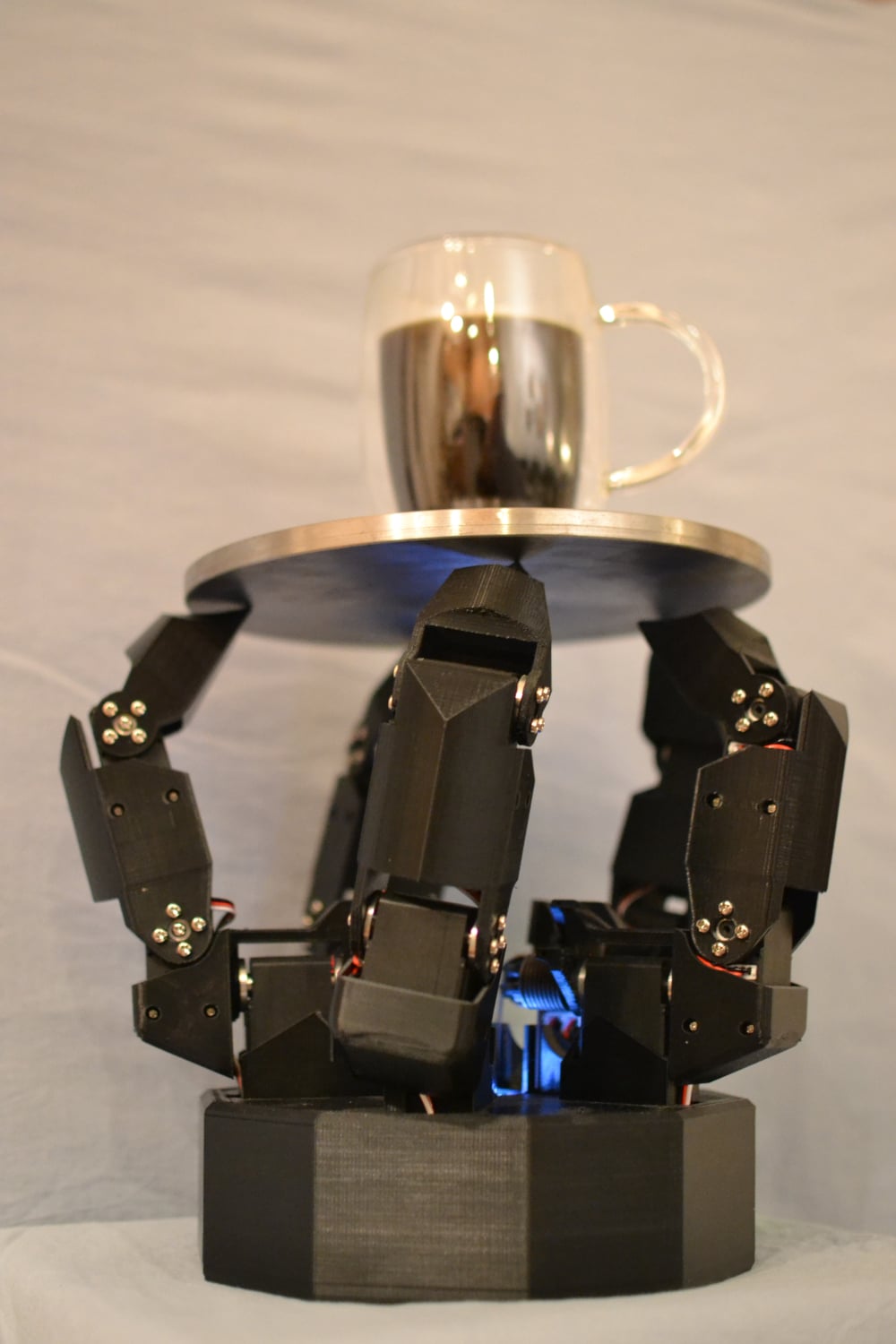
Back in the olden days, this writer briefly studied A-level mathematics. He asked the teacher what the point of calculus was, and got the answer “it’ll be useful if you do a maths degree”. Our hero, eager for knowledge, asked “what else do you get to do as part of a maths degree?”, to which the answer came, “more maths”. Sadly, this exchange persuaded him to drop the seemingly pointless study of mathematics in favour of English literature, which, though equally pointless in the grand scheme of things, was a lot more fun.
If only this beautiful creation by Anthony Pyka had been around in 1996 to inspire the young student. It’s a motorised claw which holds (and rotates) a glass disc. That sounds pretty simple, but Anthony has gone into a lot of the maths on the project GitHub, and it’s… not simple at all. Spinning a flat object around with your fingers is intuitive to anyone with decent hand-eye coordination, but when you’ve got to explain every movement to a dumb lump of silicon, the instructions do involve a lot of calculus that sadly is beyond us.
The dumb lump of silicon in this case is a Raspberry Pi 5, and it’s joined by a 12V serial bus driver to control the servos (each of the five legs has three servos). A 5V power supply for Raspberry Pi, a 12V power supply for the motor driver, and a ring of addressable LEDs round off the electronics.
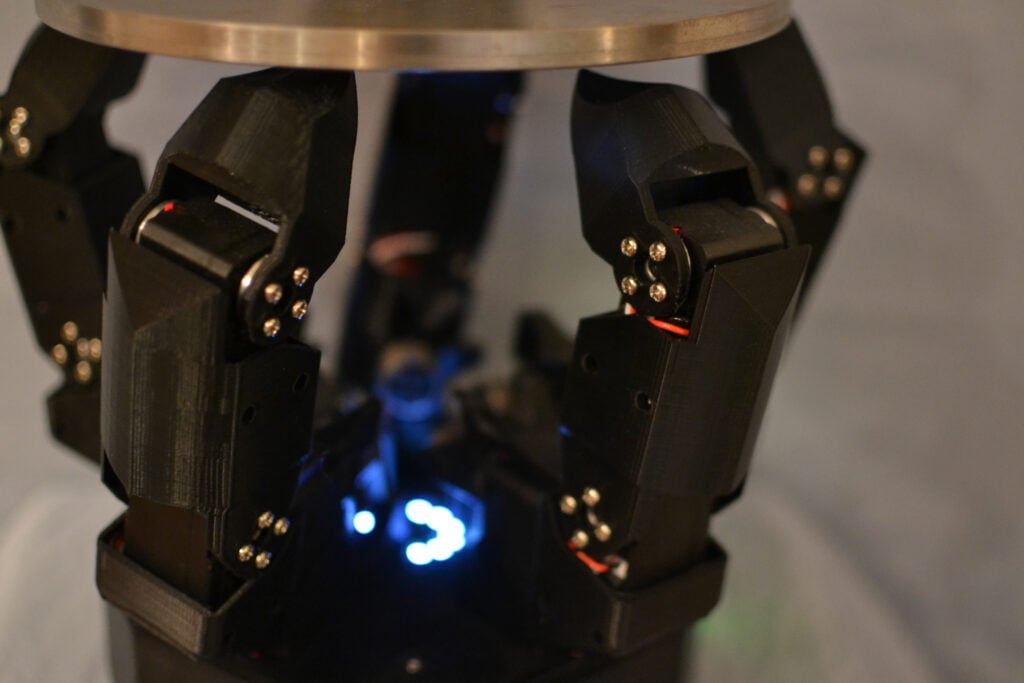
As for the reason why, Anthony told us: “Growing up, my father and I watched BattleBots quite often. During the fights where robots were being shredded to pieces, I noticed there was a giant, robotic, claw trophy stand in the background that I thought was more impressive than the bots themselves. I wanted one for myself, but after looking into it some more, I realised the stand is massive, heavy, and expensive. I decided that I could attempt to make one myself, but a smaller, cheaper desktop version to rotate my coffee mug (because why not!).
“So, during many sleepless nights of rocking my daughter back to sleep, while she drifts off, my brain… does not. I started sketching out several proof-of-concept ideas to see what parameters I could manipulate. After enough concept renditions, I modelled my way through simulations to match the parameters to real-world components and geometries. After many hours of developing calculations, simulating models, programming code, and troubleshooting mistakes, I am happy to share I completed my desktop claw stand and I could not be more proud!”

Features Editor Andrew trawls the internet for Cool Stuff while keeping the magazine running smoothly.
Subscribe to Raspberry Pi Official Magazine
Save up to 37% off the cover price and get a FREE Raspberry Pi Pico 2 W with a subscription to Raspberry Pi Official Magazine.
More articles
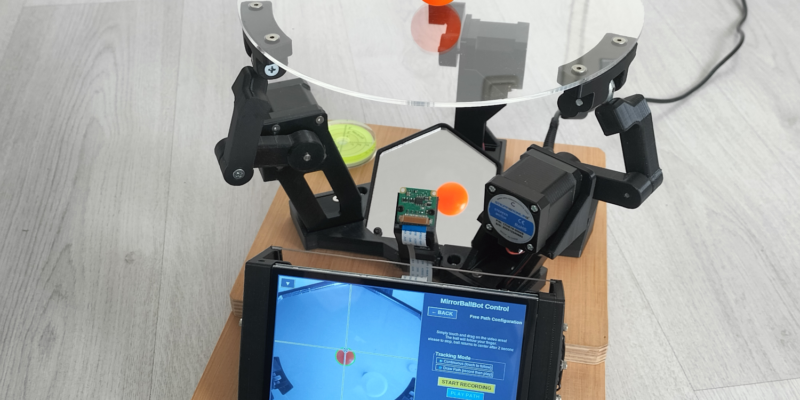
MirrorBallBot
This trick uses no smoke but it does use mirrors
Read more →
Digital Displays in Raspberry Pi Official Magazine 170
Some projects seem more like magic to us than anything else; here’s one of them. This robot by Italian engineer/magician Andrea Favero uses a mirror to widen the field of vision of a Raspberry Pi Camera Module 3, the input from which is processed by Raspberry Pi 4 and used to control three legs to […]
Read more →
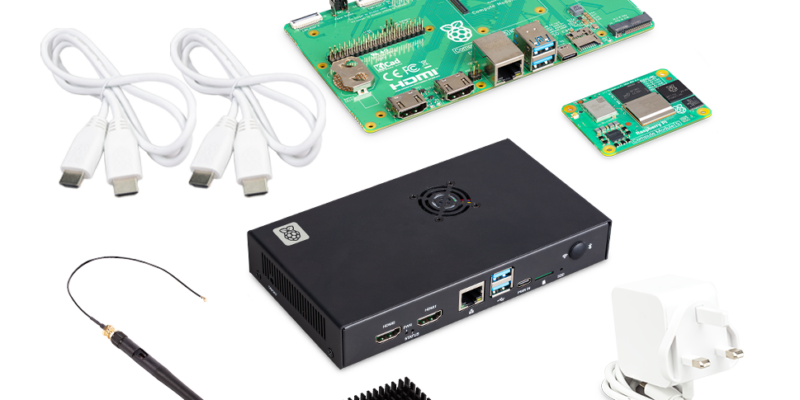
Win a Development Kit for Compute Module 5
Make CM5 development easier with our competition
Read more →