Flexible PCB watch
By Andrew Gregory. Posted
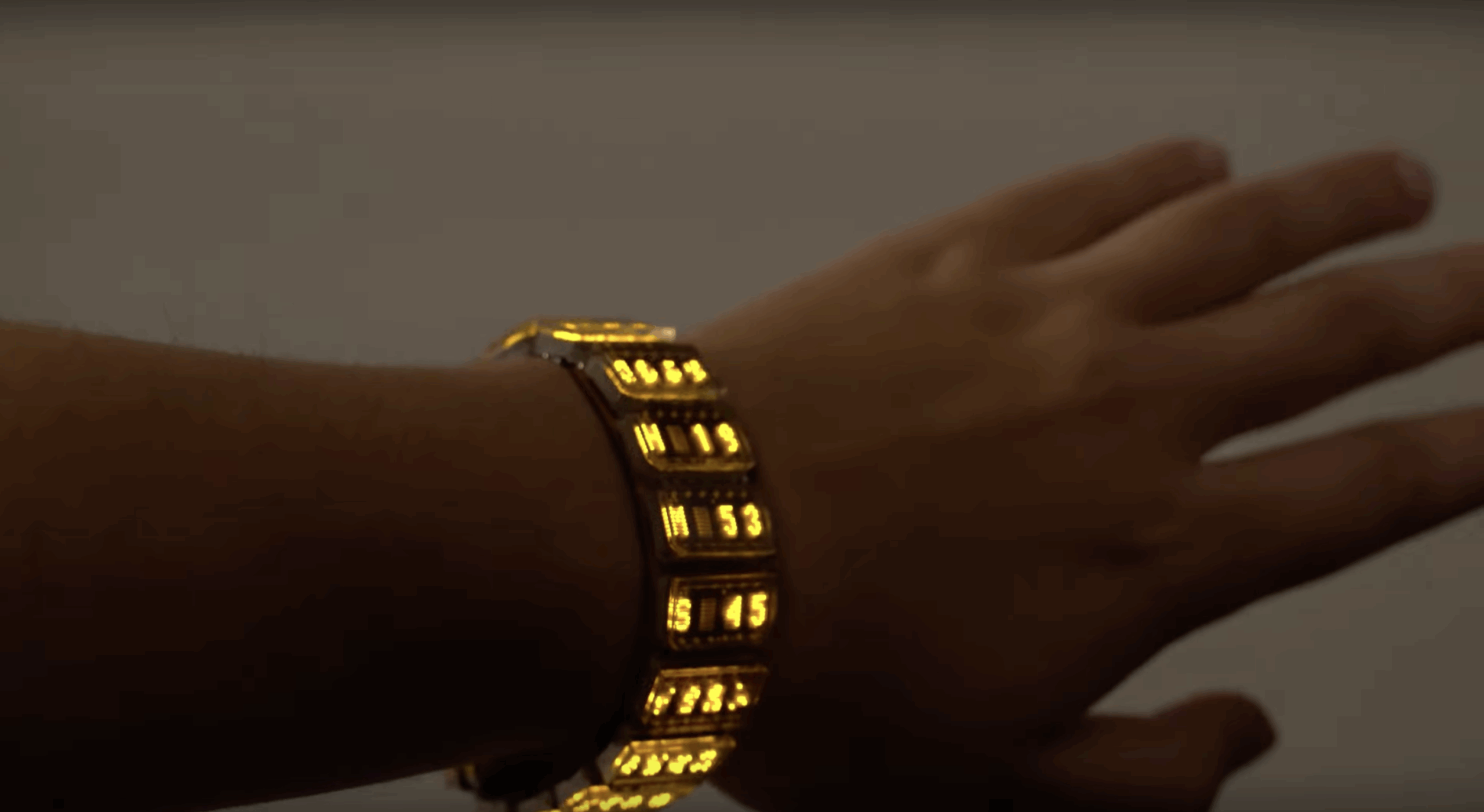
Like too many of us, YouTuber Sahko has tons of components sitting around waiting to be used. To this end, he found a load of tiny HCMS2901 displays and thought he’d turn them into a watch, mounted on a flexible PCB so you can wear it around your wrist. It’s a very cool idea: rather than a strap that holds a display, the whole thing is a continuous display, and it threw up some unusual engineering challenges.

The first of these was the choice of microcontroller; although he used a Raspberry Pi Pico in the prototyping stage, the RP2040 was just too big to incorporate in the final build, so he used the snappily named STM 32 UO0 83KCU6 instead. The other big challenge is that at full brightness, the watch uses about an amp of current, which drains the battery (salvaged from a disposable vape) in about half an hour. To get round this, the default state of the watch is to turn the display off, with the wearer pressing a button to get the time and the cool Matrix-style rainfall animation. Through-hole-soldering components on to a flexible PCB worn next to soft human skin brings its own problems. Last but not least, the cost of the displays – never mind the microcontroller and charging circuitry – came to $420, though Sahko recommends the similar HCMS3901 display as an alternative, as it’s more easily available and plays more nicely with 3.3V.

Features Editor Andrew trawls the internet for Cool Stuff while keeping the magazine running smoothly.
Subscribe to Raspberry Pi Official Magazine
Save up to 37% off the cover price and get a FREE Raspberry Pi Pico 2 W with a subscription to Raspberry Pi Official Magazine.
More articles
TinyProgrammer
Want a coding companion? TinyProgrammer lets you watch as it tinkers with Python all day. Sean McManus finds out how it works
Read more →

Make a Smart Home in Raspberry Pi Official Magazine issue 167
The dream of smart, connected devices controlling your home automatically, is especialy appealing on a lazy day when we’re trying to get work done in a heatwave. Maybe this will be the year we finally integrate temperature sensors with fans and a drinks dispenser to keep us cool, or maybe not, but we do know […]
Read more →

Win 1 of 3 Pironman 5 Pro Max cases!
Transform your Raspberry Pi with this amazing case
Read more →