Get online like it’s 1989
By Graham Morrison. Posted
This article was originally published as part of HackSpace magazine, which has since been incorporated into Raspberry Pi Official Magazine.
It’s a dark and rainy night in the mid-1980s. The CRT TV is the only light source, casting its blue rays across a Commodore 64. Someone types ‘ATDT’ into the keyboard, followed by a telephone number. A hidden modem springs to life, talking digitised squabble to another computer at the end of the telephone line. Seconds later, the C64 is connected to some remote BBS, and eight-colour ASCII art scrolls across the display, presenting a menu for news, message boards, and games. This is 1980s cutting-edge connectivity, the internet of its day.

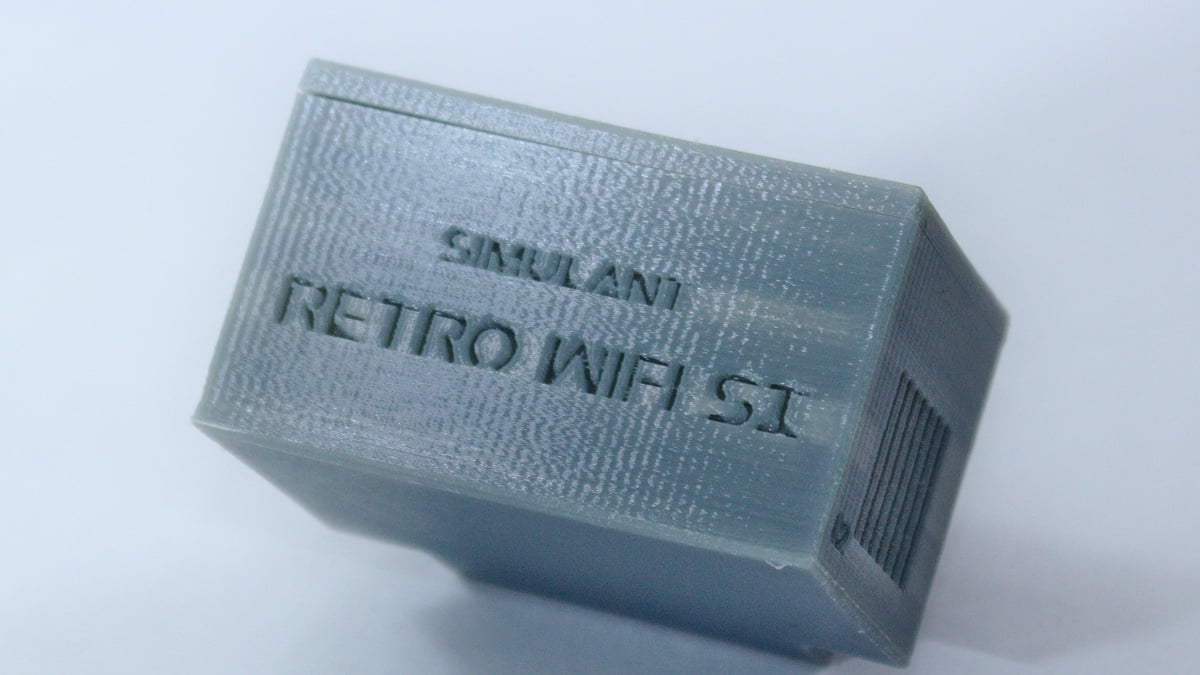
Decades later, very few dial-up bulletin board systems (BBSs) remain. But there is a growing trend to resurrect old BBSs from their last backups and make them accessible again – and the only way to really experience them is from one of those old computers. But those old computers are barely capable of connecting to anything, let alone running TCP/IP for internet access. Simulant’s Retro WiFi SI solves this problem in a 3D-printed case embedding a stack of wires and an ESP8266 chip. It connects to an old serial port, either 9-pin or 25-pin (with an adapter), takes 5 V of micro USB power, and runs an open-source firmware that operates exactly like an old-fashioned modem. This lets you use original terminal software to send the same ‘Hayes AT’ commands to make connections. But there’s one big difference: instead of negotiating a connection across a telephone line, this little box negotiates connections via your WiFi network.

Image credit GRAHAM
There’s nothing quite like the feeling of firing up your old terminal emulator, perhaps for the first time in two decades, and tentatively setting the serial port to 1200 baud. Yes, that’s 1200 bits per second. Then typing ‘AT’… if all is well, ‘OK’ appears, and you’ve been instantly transported back in time. Type ‘AT+CONFIG’ to access a menu system, allowing you to connect to the wireless network and save common phone numbers, sorry, domain names and ports. There are plenty of additional AT commands too, including comprehensive control over carriage returns, updating firmware, and hardware flow control. You change the serial speed with ATB, and we had great success on an Amiga 4000 running at 115 200 bps. You can then connect directly to any Telnet server, including those hosting an old BBS, or servers on your own machines. It works perfectly, and while we question the ‘no returns’ warranty and the lack of a bundled power supply and USB cable, the simple joy and utility the Simulant Retro WiFi SI brings to old computers makes it worth the asking price.
simulant £32.99 simulant.uk
Verdict
A brilliant way to give your retro computer a little online company.
9/10

Graham is a veteran Linux journalist who is on a life-long quest to find music in the perfect arrangement of silicon
Subscribe to Raspberry Pi Official Magazine
Save up to 37% off the cover price and get a FREE Raspberry Pi Pico 2 W with a subscription to Raspberry Pi Official Magazine.
More articles

Incredible Weather Projects in Raspberry Pi Official Magazine issue 171
If the planet gets too hot/too cold/too drizzly for human habitation, we’ll probably want to leave Earth in search of a better one. That means we’ll need a flight computer, and maker Michael Newton is one step ahead: he’s built a replica of the DSKY (display keyboard) interface from the Apollo Guidance Computer. Now you […]
Read more →

Win one of five Sense HAT bundles
Get a Sense HAT add-on and book in our latest competition
Read more →
Red Raven cyberdeck
Powered by drills
Read more →