Here boy!
By Ben Everard. Posted
This article was originally published as part of HackSpace magazine, which has since been incorporated into Raspberry Pi Official Magazine.
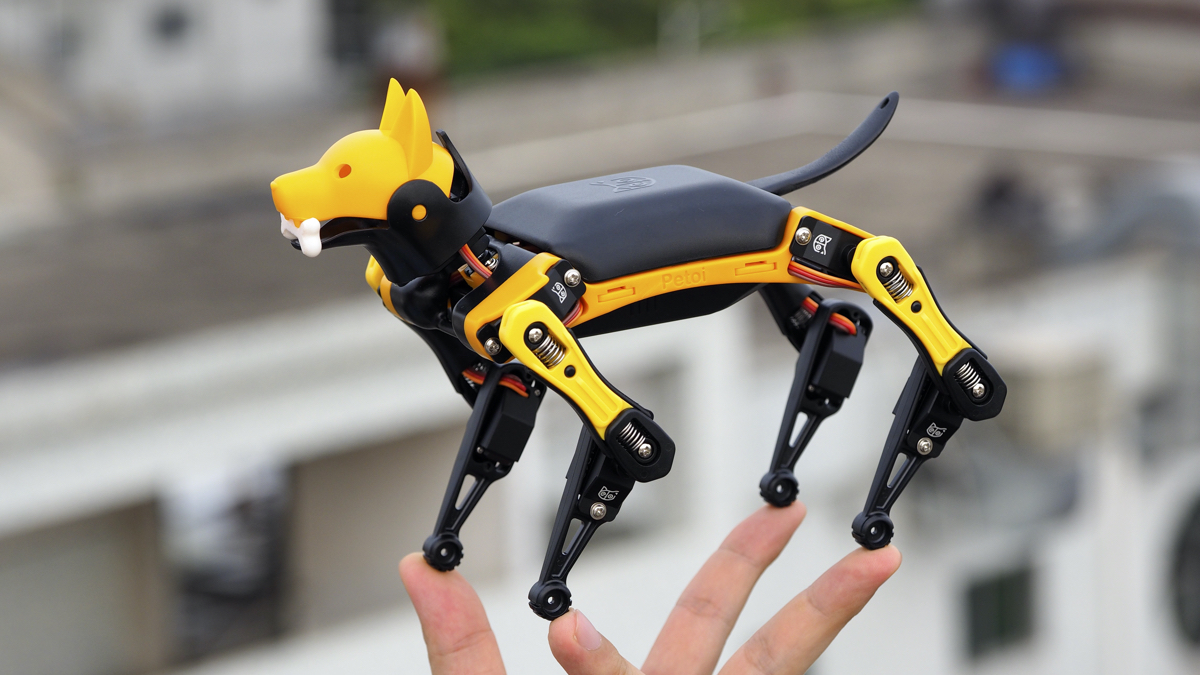
There’s something fantastically futuristic about robot pets that walk around the house. When Petoi released Nybble – a robotic cat – via crowdfunding in 2018, they unleashed the dream of electronic friendship for hundreds of people. Now they’re back with a new kit – Bittle. This time they’ve created a dog, and from what we’ve seen, it looks like a sleeker, faster robotic companion for you to build and program.
There’s a couple of things that really make Bittle stand out, compared to other walking robot kits we’ve seen: it moves much faster thanks to high-speed servos, and spring-loaded legs give a little for more natural walks.
The walking body has eight servos – two on each leg – plus a ninth to move the head. This is enough for quite a bit of motion, such as walking, and the Kickstarter video shows it at a moderate trot. For many uses, this is a sweet spot where it keeps weight, cost, and power consumption low enough, but still provides enough range of movement for some interesting movement. However, if you’re hoping for a Boston Dynamics-style running, jumping, super-canine, you might want to temper your expectations. There’s a reason the Boston Dynamics dog costs $75,000, while the full kit for Bittle is $225. That’s not cheap, but it’s at the lower-cost end of quadruped robot kits.
The real value in Bittle will depend on the programming environment. Controlling servos is easy enough from just about any language, but if you have to start from this level, it’s a very involved process to just get to a walking dog. If you can start with a reliable and easy way to get your Bittle to move around and focus on the higher-level things (such as what you want to get them to move to), it’s a more rewarding experience. While we’ve not been able to test out the Bittle, it’s based on an improved version of the NyBoard that drives the Nybble robotic cat. This provides a range of instructions that are available via IR or serial port. There are mounting points for a Raspberry Pi model A+ or Zero, so you can use this to do any higher-level processing you want, and then offload the actual movement to the NyBoard. If this works reliably, then it should provide an easy way to program your robot to move. There’s also a block-based programming environment based on TinkerGen planned.
With robots such as this, it really comes down the minutiae of how they move and what the programming environment allows. Without having one to play with, we can’t say for sure, but based on what we’ve seen, the Bittle looks like it’ll be a really fun way to add some motion to a Raspberry Pi. We’re only slightly disappointed that they chose to do a dog for this robot rather than another cat.
From $225 kickstarter.com Delivery: December 2020

Ben is the Editor of HackSpace magazine. When not wrangling words, he enjoys cycling, gardening, and attempting to identify wild mushrooms.
Subscribe to Raspberry Pi Official Magazine
Save up to 37% off the cover price and get a FREE Raspberry Pi Pico 2 W with a subscription to Raspberry Pi Official Magazine.
More articles
Red Raven cyberdeck
Powered by drills
Read more →
MirrorBallBot
This trick uses no smoke but it does use mirrors
Read more →
Digital Displays in Raspberry Pi Official Magazine 170
Some projects seem more like magic to us than anything else; here’s one of them. This robot by Italian engineer/magician Andrea Favero uses a mirror to widen the field of vision of a Raspberry Pi Camera Module 3, the input from which is processed by Raspberry Pi 4 and used to control three legs to […]
Read more →