Alcohol powered computing
By Andrew Gregory. Posted
This article was originally published as part of HackSpace magazine, which has since been incorporated into Raspberry Pi Official Magazine.

This contraption was built by Norbert Heinz to illustrate how much energy your computer uses. By turning a handle (or, more awesomely, by burning methanol in a four-stroke engine), the user gets a feel for how much power the computer demands (Norbert has also made the system run using an Arduino)

We spoke with Norbert to find out the story behind the build:
“I started diving into electronics during my apprenticeship as a physics laboratory assistant. Learning how semiconductors work was a great thing to me. I bought my first computer in those days, which was an Amiga 500 – I’m no longer a youngster – and started learning how to do coding. I scraped the parallel port of my Amiga during my early hardware experiments…
“The idea behind my internet pages is to share knowledge with mankind, as well as getting a deeper understanding of all the stuff for myself by simply writing it down. HomoFaciens is a made-up word for making humans (in short: makers), derived from Homo sapiens, which means ‘the wise man’. Creating animations is a great tool to share knowledge, so I started a YouTube channel a couple of years ago. The four-stroke generator is a less academic project – learning physics should be fun as well. My RoboSpatium is another fun part of my project. You can drive my camera-equipped robots in my attic and my garage for free. “With the hand-cranked computers, I wanted to give people a better understanding of electric power and losses or efficiency. It’s a nice demonstration; young as well as old kids enjoy powering a computer through a geared DC motor – at least for half a minute.
“The motors were left over from previous projects, and after a short test I saw that it worked. I added the four-stoke engine because I had one and I simply like the sound of those machines.”
You can see more of Norbert's creations at HomoFaciens.de

Features Editor Andrew trawls the internet for Cool Stuff while keeping the magazine running smoothly.
Subscribe to Raspberry Pi Official Magazine
Save up to 37% off the cover price and get a FREE Raspberry Pi Pico 2 W with a subscription to Raspberry Pi Official Magazine.
More articles
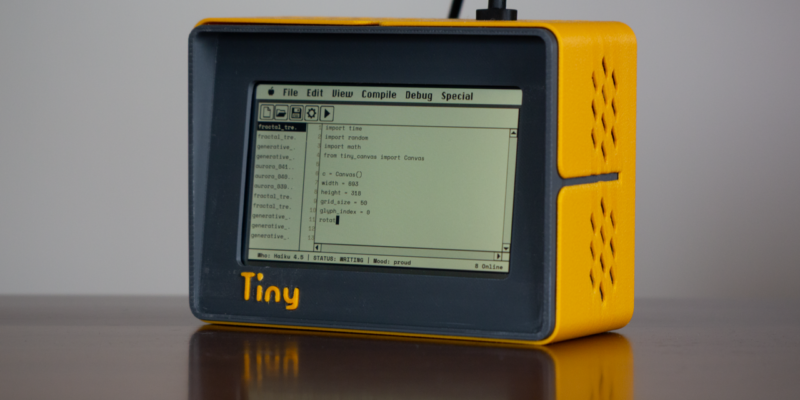
TinyProgrammer
Want a coding companion? TinyProgrammer lets you watch as it tinkers with Python all day. Sean McManus finds out how it works
Read more →

Make a Smart Home in Raspberry Pi Official Magazine issue 167
The dream of smart, connected devices controlling your home automatically, is especialy appealing on a lazy day when we’re trying to get work done in a heatwave. Maybe this will be the year we finally integrate temperature sensors with fans and a drinks dispenser to keep us cool, or maybe not, but we do know […]
Read more →

Win 1 of 3 Pironman 5 Pro Max cases!
Transform your Raspberry Pi with this amazing case
Read more →