Programming station
By Andrew Gregory. Posted
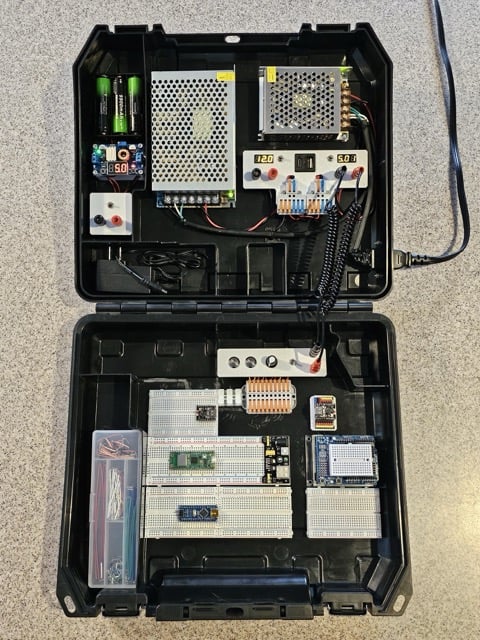
The more ideas we have, the more stuff we buy to test those ideas. So far, so good. But when shiny new toys arrive and we don’t use them immediately, they begin the process of transmutation into junk. A useful component that never gets used is junk. A tool for a job that you never do is junk. And a component or tool that you can’t find instantly becomes junk – it’s just taking up space, somewhere, with the even worse second-order effect that it makes your workspace smaller and less useful, and thus makes everything else harder to use. Oh no!
Fighting against this cycle of doom is Reddit user and electronics tinkerer Wake-Of-Chaos. They’ve been learning electronics with microcontrollers, and decided that there must be a better way than keeping all your components in the bottom of a shoebox. And so they’ve come up with this portable system that integrates breadboards, storage, and power supply.
The shell is the unused case of a power tool, with some of the ribs cut out to make space. There’s a 5V and 12V power supply, and a battery power supply. Switching options include two momentary push-button switches, a toggle switch, and a 10kΩ potentiometer, with breadboards and everything else held in place with 3D printed brackets. Just be careful when you’re taking it through airline security…

Features Editor Andrew trawls the internet for Cool Stuff while keeping the magazine running smoothly.
Subscribe to Raspberry Pi Official Magazine
Save up to 37% off the cover price and get a FREE Raspberry Pi Pico 2 W with a subscription to Raspberry Pi Official Magazine.
More articles

SPOKE review – programmable MIDI controller
An RP2040-powered touch controller for music and a lot more.
Read more →
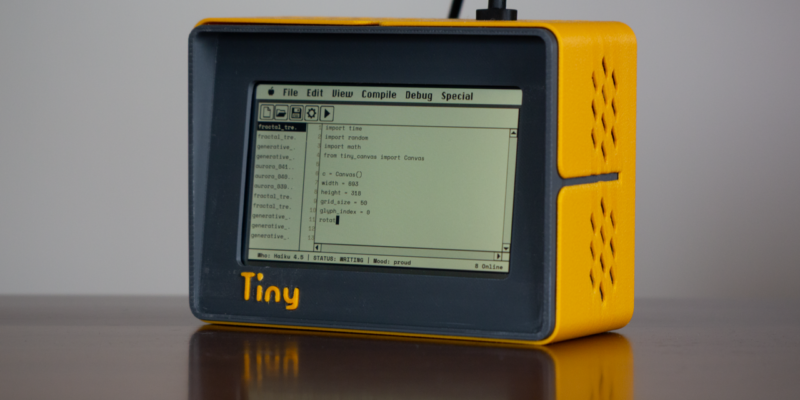
TinyProgrammer
Want a coding companion? TinyProgrammer lets you watch as it tinkers with Python all day. Sean McManus finds out how it works
Read more →
Make a Smart Home in Raspberry Pi Official Magazine issue 167
The dream of smart, connected devices controlling your home automatically, is especialy appealing on a lazy day when we’re trying to get work done in a heatwave. Maybe this will be the year we finally integrate temperature sensors with fans and a drinks dispenser to keep us cool, or maybe not, but we do know […]
Read more →