Raspberry Pi Compute Module 4 specs, benchmarks and testing in The MagPi magazine issue 99
By Gareth Halfacree. Posted

Compute Module 4 brings the power of Raspberry Pi 4 to the industrial market. With a new form factor and features, there’s a lot to unpack in Compute Module 4’s design.

In The MagPi magazine issue #99 (on sale 29 October 2020), Gareth Halfacree takes a deep dive into Compute Module 4’s specifications and performs benchmark testing. Subscribe to The MagPi magazine to get all the in-depth information delivered to your door.
The original Raspberry Pi Compute Module launched in April 2014 as a means to make it easier for engineers and professionals to put the power of Raspberry Pi into their designs. The compact Raspberry Pi Compute Module isn’t a single-board computer but a system-on-module (SOM) designed to be inserted into a carrier board.
In 2016, Raspberry Pi Compute Module 3 and Compute Module 3 Lite offered higher specifications, switching to the same processor as Raspberry Pi 3. Compute Module 3+ boosted specifications still further.
And now Raspberry Pi Compute Module 4 and Compute Module 4 Lite make the jump to the same high-performance hardware as Raspberry Pi 4.
These are the most powerful Compute Modules ever made. Eben Upton, CEO of Raspberry Pi trading and Raspberry Pi co-creator talks about Compute Module 4 in this Raspberry Pi blog post.

Meet Raspberry Pi Compute Module 4
Raspberry Pi Compute Module 4 uses a new form factor, swapping the SODIMM edge connector of earlier models to two high-density connectors on the underside. It’s a necessary change that brings all the features of the module to the Carrier Board.
This requires a change in the pins which connect the module to the carrier board. While both systems have 200 pins, the new connector is smaller and adds compatibility with new Raspberry Pi features, like the second HDMI port and PCI Express.

This means Raspberry Pi Compute Module 4 isn’t compatible with carrier boards designed for Raspberry Pi Compute Module 3.
The new SoC improves performance, the additional RAM makes it possible to work with more complex applications, and high-speed PCI Express connectivity means carrier boards have access to significantly more bandwidth.
Compute Module 4 specifications
-
SoC: Broadcom BCM2711C0 quad-core ARM Cortex-A72 (ARMv8-A) 64-bit @ 1.5GHz
-
GPU: Broadcom VideoCore VI
-
RAM: 1GB, 2GB, 4GB, or 8GB LPDDR4 SDRAM
-
Networking: Optional 2.4 GHz and 5 GHz 802.11b/g/n/ac Wi-Fi, Gigabit Ethernet PHY
-
Bluetooth: Optional Bluetooth 5.0 and Bluetooth Low Energy (BLE)
-
GPIO: Carrier board dependent
-
Interfaces: PCI Express, 2× DSI, 2× CSI, 2× HDMI
-
Storage: External (CM4 Lite); on-board 8GB/16GB/32GB eMMC (CM4)
-
Ports: Hirose U.FL antenna connector, 2× 100-pin high-density connectors
-
Dimensions: 55 mm × 40 mm × 4.5mm, 12g (exc. carrier board)

Compute Module Carrier boards
Unlike other models, Raspberry Pi Compute Module 4 has no connectors of its own – bar the U.FL antenna connector and the two high-density connectors on the underside. Instead, it relies on a carrier board – and the features available will depend on what features the carrier board breaks out.
Raspberry Pi Compute Module 4 Input/Output (IO) Board is an open-source design. It is designed to help developers get started: it brings out features including two full-size HDMI ports, Gigabit Ethernet, two USB ports, a 40-pin general-purpose input/output (GPIO) header, a Power over Ethernet (PoE) header, two DSI ports, two CSI ports for cameras, a PCI Express slot, and more.

Other carrier boards compatible with Raspberry Pi Compute Module 4 may be specialised for particular tasks, offering specific features or adding extra hardware of their own. Designers can tailor the carrier board to a particular task, but all carrier boards will be mechanically compatible with all Raspberry Pi Compute Module 4 models.
The MagPi issue #99 is on sale 29 October with in-depth benchmark testing for Compute Module 4. Buy your copy from the Raspberry Pi Press Store or subscribe now to get The MagPi magazine delivered to you door every month.

Subscribe to Raspberry Pi Official Magazine
Save up to 37% off the cover price and get a FREE Raspberry Pi Pico 2 W with a subscription to Raspberry Pi Official Magazine.
More articles

Incredible Weather Projects in Raspberry Pi Official Magazine issue 171
If the planet gets too hot/too cold/too drizzly for human habitation, we’ll probably want to leave Earth in search of a better one. That means we’ll need a flight computer, and maker Michael Newton is one step ahead: he’s built a replica of the DSKY (display keyboard) interface from the Apollo Guidance Computer. Now you […]
Read more →

Win one of five Sense HAT bundles
Get a Sense HAT add-on and book in our latest competition
Read more →
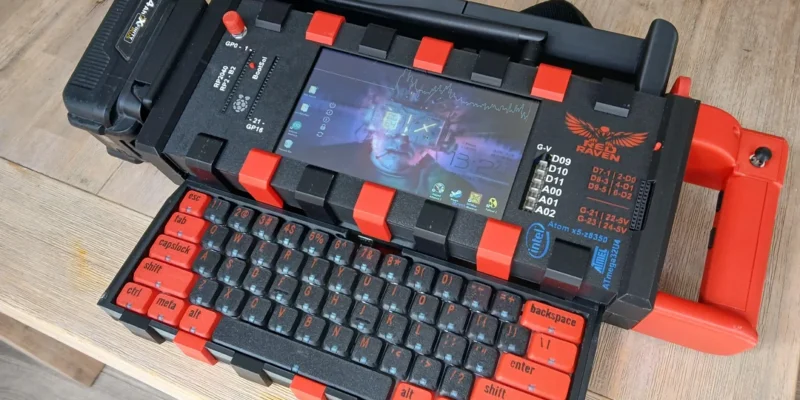
Red Raven cyberdeck
Powered by drills
Read more →