Raspberry Pi Recovery Kit project showcase
By David Crookes. Posted

Should disaster strike, a ruggedised Raspberry Pi 4 laptop may just get you out of a fix. David Crookes finds out how Jay Doscher’s tough cyberdeck could see you through the most testing of times.

Should the world ever be plunged into an apocalypse, then Jay Doscher should do just fine. He’s created a rugged-looking laptop using a Raspberry Pi 4 computer and placed it within a small, air- and watertight Pelican case. Aimed at getting technology up and running in the event of a disaster, it should see him through the most testing of times.
“Most people prioritise food and shelter in the event of a disaster, but what do you do when those are resolved – how do you get technology working again?” asks Jay, an IT professional and technology enthusiast based in the San Diego area.
“The apocalypse is more of a thought exercise for me, but I’ve certainly created a very useful computer that is much easier to work on or modify than a regular laptop.” Jay likes to focus on open-source projects, as his Twitter and Instagram feeds reveal.

Past lessons
Jay has been here before. In 2015, he popped a Raspberry Pi 2 into a weather-resistant enclosure and created the Raspberry Pi Field Unit that could run off a 12 V or higher power source, in this case a solar panel. Perfect for outdoor use, it also utilised an Adafruit real-time clock to retain accuracy when off the network. But it was far from perfect.
“The Raspberry Pi Recovery Kit is an evolution of that previous build,” he says. “Although each has different goals, I wanted a Raspberry Pi setup that could be rugged and work in a more hostile environment. I also wanted a system that could serve more than one purpose, since the Raspberry Pi platform is so flexible.”
One of the first issues he looked to address was the original lack of a keyboard. This time around, he bought a Plaid keyboard kit and, to his delight, noted that it was a perfect fit for his Pelican 1300 case. Jay also chose to use the official 7-inch Raspberry Pi touchscreen. This did away with the need for a mouse, while freeing up a much-needed USB port on Raspberry Pi 4.

With attention paid to tight wiring and realising that he could get away with powering the unit using 5 V, thereby reducing the need for 12 V circuitry, it wasn’t long before the project began coming together. “A Raspberry Pi computer is perfect for this project because it’s small, flexible on GPIO, and has great support for third-party add-ons like the GPIO breakout HAT I used,” Jay says.
Future-proofing
For a neat interior and to ensure all of the components could be easily held in place, internal parts were printed on a Prusa i3 MK3S 3D printer. For the host of connectors, a panel was produced with locking switches that could turn individual components on and off. These allowed control over Raspberry Pi 4, display, and Netgear five-port Ethernet network, saving power in a potential emergency. A switch also allows toggling between an internal and external battery.

“The internal battery has been the most difficult part, and I am still working on that,” Jay says. “There are no real considerations on the Raspberry Pi board itself for battery management, and Raspberry Pi 4 was pretty power-hungry when I built this kit.”
Thankfully, coding proved easier. “It’s a regular Raspberry Pi laptop in many ways, but I am working on scripts to mirror my GitHub projects, Wikipedia and Raspbian APT libraries while following their guidelines on proper mirroring,” he reveals.
The result is a cyberdeck that can work as a portable standalone network core if needed. “It’s a great system to keep air-gapped from the rest of the network when not in use,” Jay concludes. The battle for survival starts here.
Quick facts
-
No holes were drilled into the Pelican case
-
The entire device is kept watertight
-
The main frame took 24 hours to 3D-print
-
It can be powered internally and externally
-
It’s stored in an electromagnetic pulse shielding box

Subscribe to Raspberry Pi Official Magazine
Save up to 37% off the cover price and get a FREE Raspberry Pi Pico 2 W with a subscription to Raspberry Pi Official Magazine.
More articles
MirrorBallBot
This trick uses no smoke but it does use mirrors
Read more →

Digital Displays in Raspberry Pi Official Magazine 170
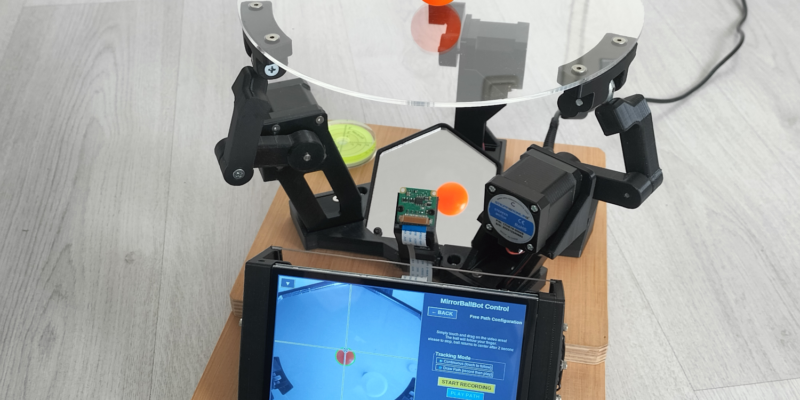
Some projects seem more like magic to us than anything else; here’s one of them. This robot by Italian engineer/magician Andrea Favero uses a mirror to widen the field of vision of a Raspberry Pi Camera Module 3, the input from which is processed by Raspberry Pi 4 and used to control three legs to […]
Read more →
Win a Development Kit for Compute Module 5
Make CM5 development easier with our competition
Read more →