Raspberry Pi Ri
By Rob Zwetsloot. Posted

While we love our Raspberry Pi 400, we find ourselves using a regular Raspberry Pi for electronics projects, so we’re never too far away from the GPIO pins. Elijah Horland, a young maker who you may know from MythBusters Jr., came up with a clever solution for just this purpose: “It’s an ‘underpinned’ clip-on breadboard for Raspberry Pi 400, sort of a pin-pad for the keyboard form factor,” says Elijah.
“I was using Raspberry Pi 400, and I had a small problem with the placement of the GPIO,” he tells us. “I couldn’t reach it without turning the entire thing, and it would stop my workflow to plug things in. The lack of labelling on a breadboard is also a problem for me. I keep GPIO pinouts up on my walls, but that’s really just a patch, not a solution.”
Elijah also managed to spread out the GPIO pins in the process, retaining some ‘real-estate’ on the breadboard.

Hidden benefits
“While it does help me work faster, it would also help a beginner who does not know what GPIO pins are what, because it has a label on it,” Elijah reckons. “On top of that, it hides the T-connector under the breadboard, which saves pins one-to-three on each side of the breadboard. When there are only five pins that directly connect with the GPIO pins, every saved space counts.”
Apparently it also stops the whole thing sliding around a bit – the ribbon cable is stiff and has a habit of moving the breadboard around as it flexes and moves.

“The Ri fixes that by keeping the breadboard where a ‘numpad’ would usually be on a full-sized keyboard,” Elijah explains. “If the normal breadboard size is too small for the project that you are doing, you can always just swap it out for a bigger breadboard, because it used the standard side pins of the breadboard to hold itself to the 3D print.”
Now and then
While it’s helped Elijah with productivity, he isn’t finished with the project yet, and has some future plans for it.

“I plan to uncover the two vent holes by having the 3D print connect using the GPIO pins instead of clipping to the side of the board,” Elijah says. “Underpinned trays for a breadboard for Pico, [Raspberry Pi Zero] W, and [Model] B form factors are also planned for after the school year.”
If you want to make your own, Elijah has put the 3D model for the little underpinned holder up on Thingiverse.

Rob is amazing. He’s also the Features Editor of Raspberry Pi Official Magazine, a hobbyist maker, cosplayer, comic book writer, and extremely modest.
Subscribe to Raspberry Pi Official Magazine
Save up to 37% off the cover price and get a FREE Raspberry Pi Pico 2 W with a subscription to Raspberry Pi Official Magazine.
More articles

Incredible Weather Projects in Raspberry Pi Official Magazine issue 171
If the planet gets too hot/too cold/too drizzly for human habitation, we’ll probably want to leave Earth in search of a better one. That means we’ll need a flight computer, and maker Michael Newton is one step ahead: he’s built a replica of the DSKY (display keyboard) interface from the Apollo Guidance Computer. Now you […]
Read more →

Win one of five Sense HAT bundles
Get a Sense HAT add-on and book in our latest competition
Read more →
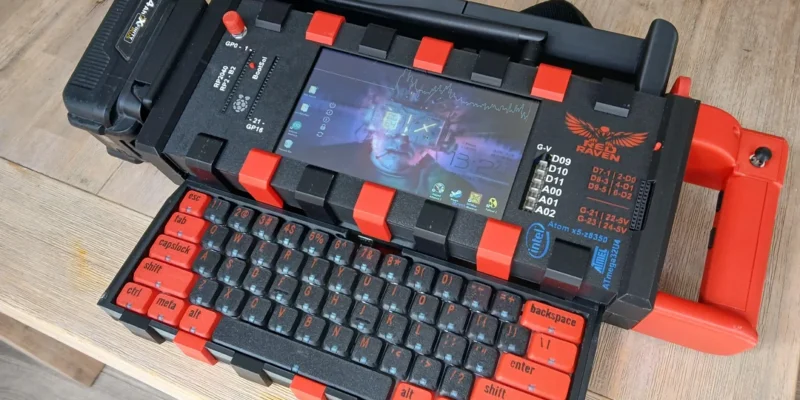
Red Raven cyberdeck
Powered by drills
Read more →