Raspberry Pi Zero 2 W
By Ben Everard. Posted
This article was originally published as part of HackSpace magazine, which has since been incorporated into Raspberry Pi Official Magazine.

In February 2012, Raspberry Pi launched their first computer, based on the BCM2835 system on a chip. A lot has changed in the intervening 9 years, but the little BCM2835 has remained in the Raspberry Pi lineup. After the Raspberry Pi 2 supplanted version 1 in 2015, the BCM2835 lived on in the Raspberry Pi Zero (and later the Zero W). It’s continued to power projects big and small and provide cheap access to computing around the world. However, after 9 years of service, is it time to let this little chip slip into a dignified retirement (though the original Zero will still be available).

The Raspberry Pi Zero 2 W is a pin-compatible replacement for the original Zero (or Zero W) that brings in a significant boost in processor performance. The BCM2710 silicon die (which particularly avid Raspberry Pi watchers will recognise from the Raspberry Pi 3) brings in four cores running at 1GHz. The single-core performance is about 40% up and with four of them, any multi-threaded workload will see a significant uplift.
Alongside this there is the same features that we know and love from the original Zero: 512Mb of RAM, MicroSD card, Mini HDMI, USB 2.0 OTG, micro HDMI, Micro USB (for power), Raspberry Pi-standard 4-0 pin header and camera connector. In other words, if you can connect a thing to a original Zero, you can connect it to the Zero 2 and get added processor power.
This is a whole heap more processor performance, but what does this mean in use? Obviously if you’re a Zero as a desktop, upgrading will make a huge difference to day-to-day use, but a large amount of Zeros are embedded in projects. The small size and price makes this little board great for adding processing power to – well, just about anything.
While the speed boost will be great for all users, there's a few areas that we think will particularly benefit from the extra speed.
Machine learning — such as Tensorflow — can add features such as object recognition to cameras, but is a CPU hog. The added processor power will be a huge boost for these and should mean more complex models can run in real time.

The small size of the Zero makes it a popular choice for handheld-gaming, and the added processing power will mean more games will run. Added to this the fact that it’s the same form-factor and it’s a drop-in speed-boost for gamers.
The speedup — and particularly the extra processing cores — mean that the Zero can do more in parallel, such as hosting a web interface and controlling hardware. Two tasks that 3D printer-controller OctoPrint needs to do. While the original Zero wasn't recommended for OctoPrint, the new Zero 2 works well and is supported.
After six years, the Zero is long-due an upgrade. The new Zero 2 W keeps the small size and form-factor of the original Zero and boosts the performance. This big leap in performance brings both a bit more slickness to the desktop and a whole lot more possibilities for projects. We’re looking forward to seeing what you all build with it.

Ben is the Editor of HackSpace magazine. When not wrangling words, he enjoys cycling, gardening, and attempting to identify wild mushrooms.
Subscribe to Raspberry Pi Official Magazine
Save up to 37% off the cover price and get a FREE Raspberry Pi Pico 2 W with a subscription to Raspberry Pi Official Magazine.
More articles
Incredible Weather Projects in Raspberry Pi Official Magazine issue 171
If the planet gets too hot/too cold/too drizzly for human habitation, we’ll probably want to leave Earth in search of a better one. That means we’ll need a flight computer, and maker Michael Newton is one step ahead: he’s built a replica of the DSKY (display keyboard) interface from the Apollo Guidance Computer. Now you […]
Read more →
Win one of five Sense HAT bundles
Get a Sense HAT add-on and book in our latest competition
Read more →
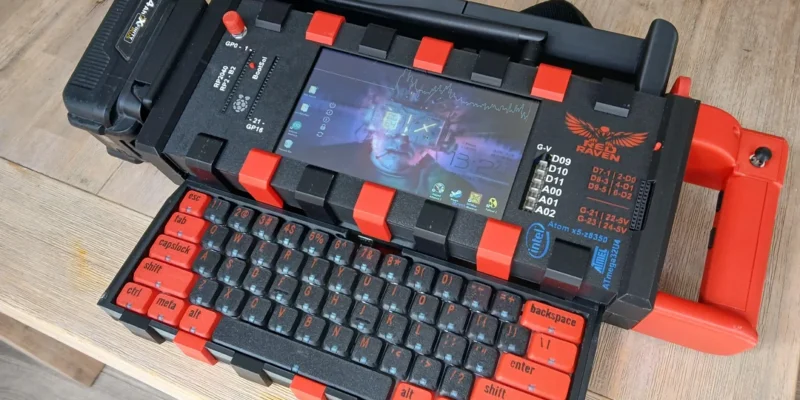
Red Raven cyberdeck
Powered by drills
Read more →