RasPiO Analog Zero
By Russell Barnes. Posted

It makes the reading of analogue sensors as easy as Pi
While its mini form factor makes the Analog Zero a perfect partner for the Pi Zero, it’s a great way to add easy-to-use analogue inputs to any Raspberry Pi model. Supplied as a kit, it’s based around the MCP3008 analogue-to-digital converter (ADC) chip, but avoids all the intricate wiring usually required when using an ADC.
The full article can be found in The MagPi 48 and was written by Phil King
The great thing about using this particular chip is that it’s already supported by the GPIO Zero Python library with its own class, so it’s a doddle to start writing programs to read and compare up to eight analogue inputs at once. Just use jumper wires to hook up your analogue sensors – temperature probes, light-dependent resistors, humidity sensors, gas detectors, potentiometers etc. – to any of the eight inputs in a female header, then write a few lines of code to get instant readings. Voltages up to 3.3V can be read directly; if the input is higher, you’ll need to use a voltage divider made from resistors. Potential projects include a digital thermometer, voltmeter, and weather station, and kits for all of these were offered as part of the Analog Zero’s successful seven-day Kickstarter campaign.
If you require greater accuracy than the MCP3008’s 10 bits, you always have the option of swapping it out for your own 12-bit MCP3208 ADC chip for extra precision, since it fits the same socket and is also supported by GPIO Zero. Even so, the MCP3008’s 1,024 steps should be enough for most projects.
Although the Analog Zero makes things easier once assembled, note that you do have to do a bit of soldering beforehand, but everything’s well marked out on the board. As well as the chip socket, you’ll need to solder on the small female header for the analogue inputs, a couple of capacitors, a jumper switch, plus a 40-way female header to connect to the Pi’s GPIO port. Handily, the board features through-holes for 25 GPIO pins, along with a mini 54-point prototyping area. There’s also the option to create a sleeker version by soldering the chip directly to the board and using surface-mount capacitors on the rear.
Last word
4/5
We’d have appreciated a pre-assembled option, but once you’ve soldered the kit components onto the board, the Analog Zero really does make it much easier to use multiple analogue inputs for projects, particularly when using GPIO Zero.

Russell runs Raspberry Pi Press, which includes The MagPi, Hello World, HackSpace magazine, and book projects. He’s a massive sci-fi bore.
Subscribe to Raspberry Pi Official Magazine
Save up to 37% off the cover price and get a FREE Raspberry Pi Pico 2 W with a subscription to Raspberry Pi Official Magazine.
More articles
Incredible Weather Projects in Raspberry Pi Official Magazine issue 171
If the planet gets too hot/too cold/too drizzly for human habitation, we’ll probably want to leave Earth in search of a better one. That means we’ll need a flight computer, and maker Michael Newton is one step ahead: he’s built a replica of the DSKY (display keyboard) interface from the Apollo Guidance Computer. Now you […]
Read more →

Win one of five Sense HAT bundles
Get a Sense HAT add-on and book in our latest competition
Read more →
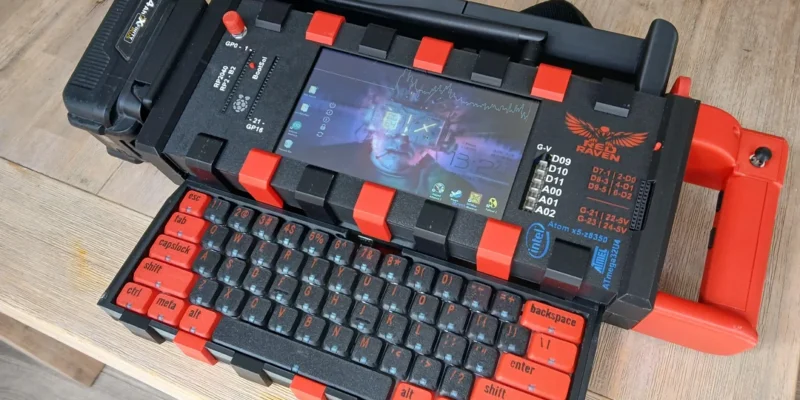
Red Raven cyberdeck
Powered by drills
Read more →