Ringo phone review
By Ben Everard. Posted
This article was originally published as part of HackSpace magazine, which has since been incorporated into Raspberry Pi Official Magazine.
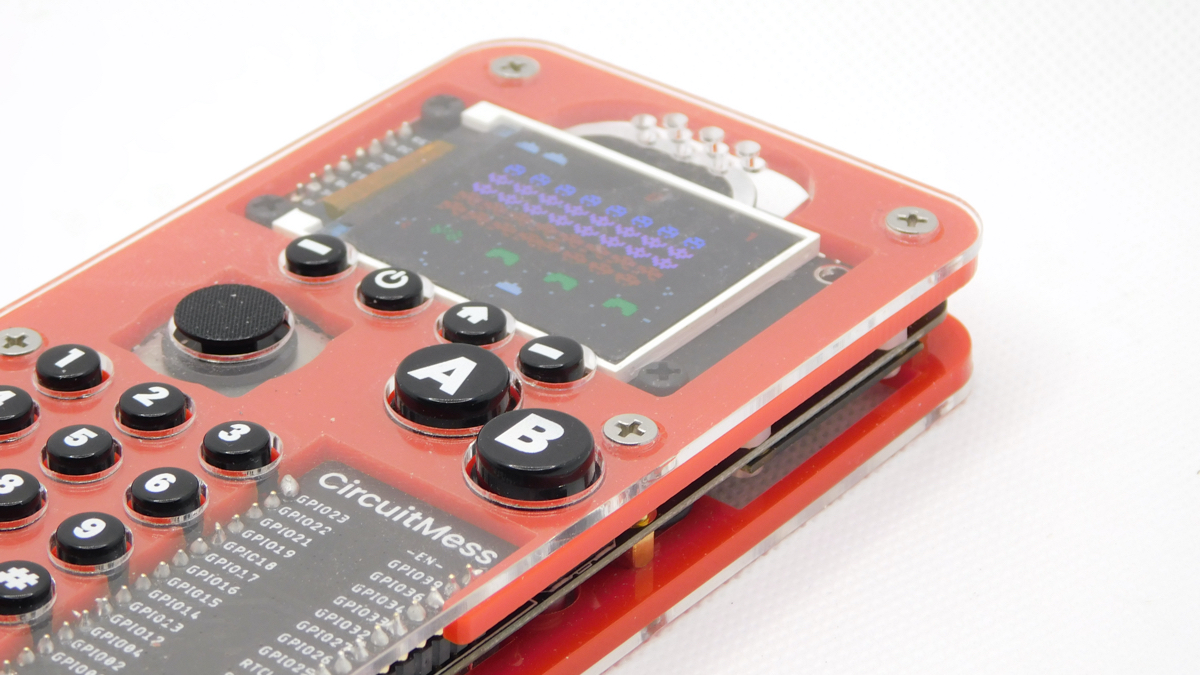
The Ringo (formerly known as MAKERphone) is an open-source, DIY phone. It has an ESP32-based microcontroller board at its heart that can run Arduino or MicroPython code. This solders onto a mainboard that has buttons, a screen, and a connector for either a 2G or 4G mobile phone module. These electronics bolt into a case of four bits of laser-cut acrylic to create a mobile phone. A slightly bulky phone, and one based on buttons rather than a touchscreen (as many modern phones are), but a phone nonetheless.
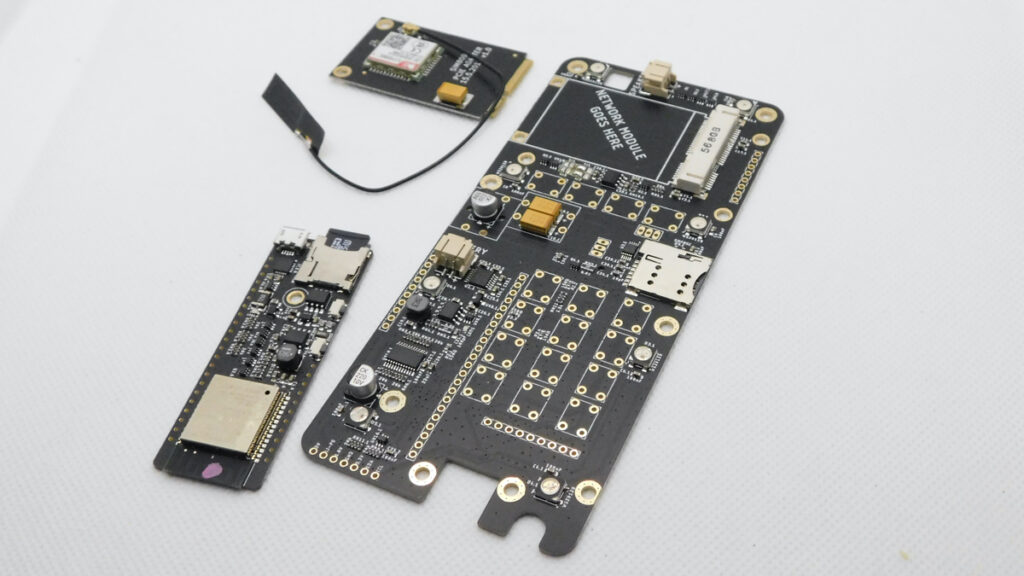
When you open the box, you’re confronted with a set of circuit boards (with the surface-mount components already soldered on), a bag of components, and the bits for the case. It’s up to you to put this together. You can also optionally get a tools kit that contains a USB-powered soldering iron, pliers, desoldering pump, and a few other bits.
Make beautiful beats with the complete Raspberry Pi music production toolkit.
The step-by-step instructions (available at circuitmess.com/build) take you through the whole process very easily. Since all the surface-mount components are in place, there’s only through-hole soldering left to do, and it’s all quite accessible. While a complete beginner might feel a little nervous starting out with an expensive kit like this, there aren’t any bits that should cause problems, and everything is forgiving. The first step is to solder the headers onto the controller board, and this gives an easy introduction to soldering. You can also remove these without too much difficulty should you make a mistake (we can speak from experience here, as we failed to follow the instructions – a fault of our hubris, not the clear instructions – and soldered them on the wrong side of the board).
The exact model of speaker has changed slightly since the instructions were written, and is a little tight to get behind the screen, but if you loosen off the bolts on the screen, it slots into place without much difficulty. One of the speaker wires broke on our model (CircuitMess tells us that it had a slight problem with a supplier), but it took just a quick drop of solder to fix.
Software
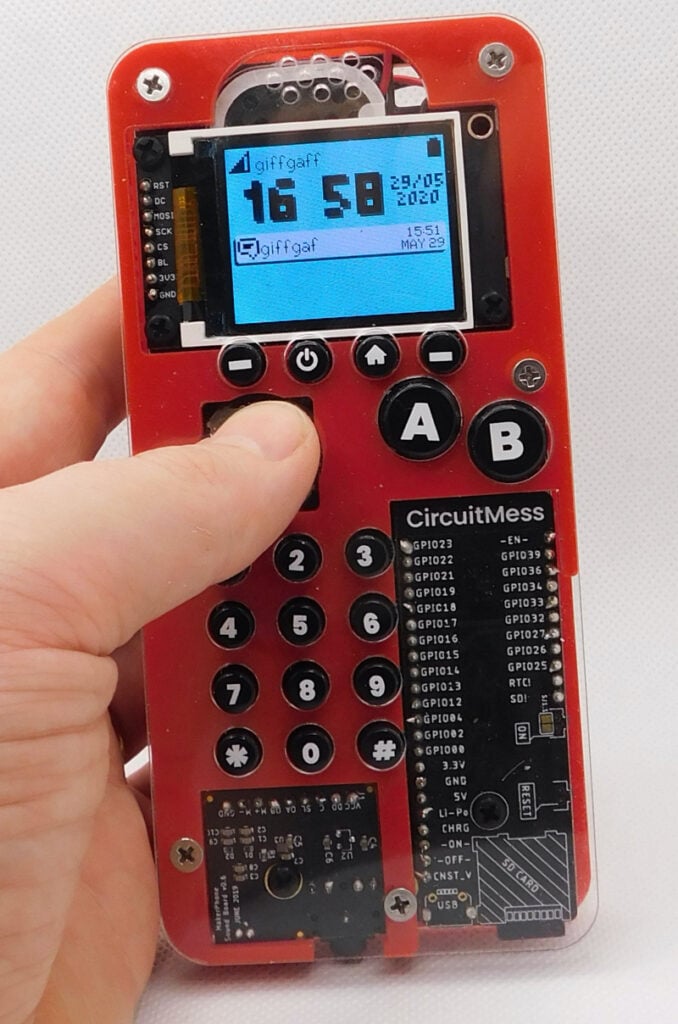
The phone software is reminiscent of early 2000s phones. The screen is colour, but the resolution is much lower than most modern phones (160×128 pixels). The joystick feels good under the thumb (it’s analogue if you want to make use of this in your own software). The phone comes with a few basic apps for phone, SMS messaging, contacts, torch (or flashlight for our American friends), a music player (WAV files only), an image viewer, and there are three (quite addictive) games: Space Invaders, Pong, and Snake.
The real advantage of this phone is not the software it comes with, though: it’s that you can make your own quite easily. There’s support for MicroPython and Arduino, as well as CircuitBlocks which gives you a drag-and-drop Scratch-like interface to the phone’s Arduino library. The firmware on the phone allows you to use these languages to create apps that can be loaded interactively and will be interrupted by phone calls and messages. As yet, there’s not much of an ecosystem of apps available for this, but it’s a new platform, and this may change in the coming months.
While the ESP32 does have WiFi and Bluetooth, the only default application that makes use of this is the firmware updater. Should you wish, you may be able to make use of these in your own applications.
In your pocket
While this is a fun project to make, the real test of any project is how it works once it’s made. On the simplest level, this makes a perfectly good phone. You can make calls and send SMS messages easily (though you have to be old-school enough to remember how to type on a digit keypad, as the letters aren’t printed on). We found that the phone battery lasted a couple of days with light use.
However, few of us use phones as phones these days. The Ringo phone doesn’t compare to a modern iPhone or Android device. There’s no web browser, no camera, no WhatsApp, etc. For some people, this will be an advantage, and for them, Ringo is an interesting option. It’s distraction-free, so you won’t be sucked into social media black holes, or feel you have to photograph every meal. However, at the same time, if you do find you need extra little features (and if you’ve got the programming skills), you can implement them yourself.
Phones are now the visible face of high technology and are often seen as black-box devices that hold enormous power over our everyday lives. The Ringo is a phone that we can control in almost any way we want, as a tool for helping to understand technology and our relationship with it. For some, it’ll be a fun project and a curio; for others, it’ll be the basis of their personal communications that they retain control of. Either way, it’s an entertaining kit to build and play with.
circuitmess £129.99 circuitmess.com
Verdict
We had great fun putting this phone together. It’s one of the better maker kits around, and could be a useful, customisable gadget.
10/10

Ben is the Editor of HackSpace magazine. When not wrangling words, he enjoys cycling, gardening, and attempting to identify wild mushrooms.
Subscribe to Raspberry Pi Official Magazine
Save up to 37% off the cover price and get a FREE Raspberry Pi Pico 2 W with a subscription to Raspberry Pi Official Magazine.
More articles
Use a robot to build a robot
This glorious, (mostly) 3D printed robot has six degrees of freedom.
Read more →
Make Music With Raspberry Pi in Official Raspberry Pi Magazine issue 166
Music production is an esoteric world of chin stroking and arguing over what kind of valve makes the best sound in a guitar amplifier – at least, it can be. Load up on software, bring your friends, and record your latest masterpiece on Raspberry Pi. We bring news from the world of 3D printing, where […]
Read more →
Win one of ten Sixfab AI HAT+
The new add-on could be yours
Read more →