The Computer Mouse with Pi Zero W, keyboard, and screen
By Lucy Hattersley. Posted

Look up in the sky! Is it a mouse? Is it a screen? No, it’s computer mouse! Rob Zwetsloot gets the scoop on our newest project hero
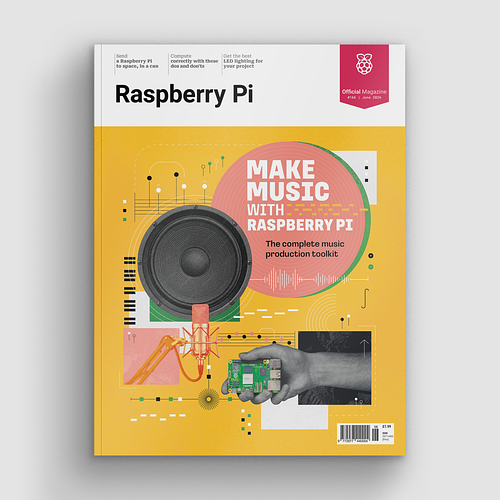
Make beautiful beats with the complete Raspberry Pi music production toolkit.
When the Raspberry Pi Zero first launched, we all thought about stuff we could make with it. Some of those can be found way back in issue 40’s Pi Zero launch feature. However, one we didn’t talk about was Eben Upton’s idea: the Raspberry Pi co-creator wondered if there was a way to play DOOM with a plug-and-play mouse.
While perhaps a little tricky with no keyboard, it’s an interesting idea, and we’ve seen versions of it since then. This project by Thomas (aka Electronic Grenade) takes the concept to a whole new level though by putting an entire computer into a mouse.
Fast facts
- The computer mouse took about two months to complete
- The 3D-printed parts took an entire month to design
- The screen is only 1.5-inch, and can fold down for easy transport
- Two mice were used for parts in the build
- Thomas has also built a Raspberry Pi-powered laptop
The Computer Mouse: Keyboard, check. Monitor, check
“My latest project is called ‘the computer mouse’,” Thomas tells us. “It is a fully fledged computer in the shape of a mouse. It has a keyboard, a screen, and works like a normal mouse. This project uses the Raspberry Pi Zero W along with an OLED display and a Bluetooth keyboard.”
With the ease of setting up Bluetooth devices, and the ability to connect to a wireless network without any dongles, the Pi Zero W was the natural choice for Thomas.
“I thought of this idea after seeing a project where somebody put a Raspberry Pi and a battery into a keyboard,” he explains. “It had an HDMI cable coming out of the keyboard that plugged into a monitor so that it could be used as a fully fledged computer. After seeing that, I thought it would be neat to try and do the same but with a mouse. But instead of having to plug it into a monitor and keyboard, both of those things would be part of it.
“When I started, I envisioned it looking like an ordinary mouse, but with a sliding keyboard and a fold-out monitor. After I got the mouse and all of the parts, though, I realised that it wasn’t going to fit into the mouse. So I started designing my own mouse in Fusion 360, which is a 3D CAD program. After multiple redesigns, I printed it out and put all of the parts inside.”

All the parts inside
The parts of the original mouse were stored inside the new mouse chassis, along with the tiny screen and the pop-out Bluetooth keyboard.
“It works pretty much as expected. It takes around 30 seconds to boot up, and you can run most applications just fine,” Thomas says. “There are a couple design flaws that I would definitely change if I decide to make a second attempt at this. The mouse’s sensor isn’t very sensitive due to the way I have it in the housing, which makes it sometimes not sense movement. I would definitely make some improvements to that. I would also redesign the tracks that the keyboard slides on to be sturdier. As it is now, the keyboard is very loose feeling when it is extended.”
To be honest, we want a kit of this mouse, so we’re hoping he works out the kinks. Otherwise, we’re looking forward to seeing what other cool and crazy stuff Thomas makes in the future.

Using the Computer Mouse



Lucy is Editor of Raspberry Pi Official Magazine.
Subscribe to Raspberry Pi Official Magazine
Save up to 37% off the cover price and get a FREE Raspberry Pi Pico 2 W with a subscription to Raspberry Pi Official Magazine.
More articles
Make Music With Raspberry Pi in Official Raspberry Pi Magazine issue 166
Music production is an esoteric world of chin stroking and arguing over what kind of valve makes the best sound in a guitar amplifier – at least, it can be. Load up on software, bring your friends, and record your latest masterpiece on Raspberry Pi. We bring news from the world of 3D printing, where […]
Read more →
Win one of ten Sixfab AI HAT+
The new add-on could be yours
Read more →
ISS Tracker
Space age is no longer a synonym for futuristic; space age means things that originated in the last millennium.
Read more →