Raspberry Pi Zero production getting on track
By Russell Barnes. Posted

First-party production led to scaling challenges for the Raspberry Pi Zero
The launch of the Raspberry Pi Zero, the world’s first fully functional microcomputer to cost just £4/$5, caused quite a stir. Unsurprisingly, given the precedent of the Foundation’s other launches, initial stock sold out within minutes. What has been more surprising is that stock continues to be elusive, with small batches appearing in the official sales channel only to immediately disappear again under a flood of demand.
The scarcity of the Pi Zero has led to a ‘black market’ of sorts appearing. When we gave away a cover-mounted Zero with issue 40, we were disappointed to see auction sites filled with opportunists trying to profit from purchases from supermarket shelves.
Even now, there are unscrupulous outlets looking to profit from the high demand for the device. Some retailers have taken to buying up stock from the official outlets in order to resell at a substantial mark-up; one seller was recently found to be adding a pair of cheap adaptor cables to the Pi Zero in order to attempt to justify a £36 selling price.

Buyers are disappointed that they can’t easily get their hands on one or more Pi Zeros for their planned projects, and doubly so when they see rampant profiteering. Fortunately, there’s light at the end of the tunnel: production is being ramped up to meet demand.
“I placed another 150,000 POs [production orders] – well, a pair of POs, a 50K and a 100K – in the last couple of days,” Raspberry Pi Foundation co-founder Eben Upton explained during an interview in early February. “It’d be good to get to a point where we’re doing at least 50,000 a month for Zero. I think we could do 50,000 a month on Zero pretty comfortably.”
But, given the tradition for new Pi models to sell out at launch, why is it taking so long to ramp up production on the Zero? The answer lies in the board’s unique position, Eben reveals. “This isn’t quite the same as the other Pis, because the other Pis are made by RS and Farnell. We make these Pis, so you’re actually looking at a small company trying to scale.”
“We’ve got good resources and good engineers, but you’re looking at a small company trying to scale production,” Eben continues. “It’s not quite realistic to compare the [Pi Zero] throughput to the throughput of the big Pis, because the big Pis are being made by billion-dollar, billion-pound companies; the Zero’s being made by us.”
The launch of the Pi 3 won’t see the Zero put on the back-burner, though. “If we can get it stable at 50,000 a month,” Eben promises, “then we can look at how we can scale up from that.”
This news piece will be published in The MagPi 43, out this Thursday, and was written by Gareth Halfacree

Russell runs Raspberry Pi Press, which includes The MagPi, Hello World, HackSpace magazine, and book projects. He’s a massive sci-fi bore.
Subscribe to Raspberry Pi Official Magazine
Save up to 37% off the cover price and get a FREE Raspberry Pi Pico 2 W with a subscription to Raspberry Pi Official Magazine.
More articles
Incredible Weather Projects in Raspberry Pi Official Magazine issue 171
If the planet gets too hot/too cold/too drizzly for human habitation, we’ll probably want to leave Earth in search of a better one. That means we’ll need a flight computer, and maker Michael Newton is one step ahead: he’s built a replica of the DSKY (display keyboard) interface from the Apollo Guidance Computer. Now you […]
Read more →
Win one of five Sense HAT bundles
Get a Sense HAT add-on and book in our latest competition
Read more →
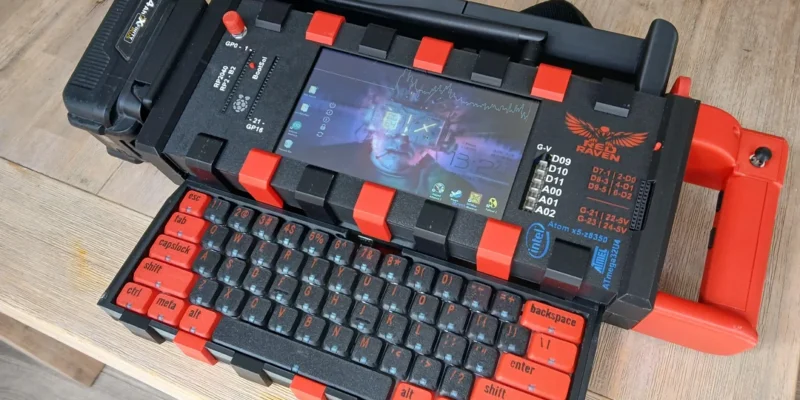
Red Raven cyberdeck
Powered by drills
Read more →