Soundscapes to Landscapes
By Cameron Norris. Posted
This article was originally published as part of HackSpace magazine, which has since been incorporated into Raspberry Pi Official Magazine.
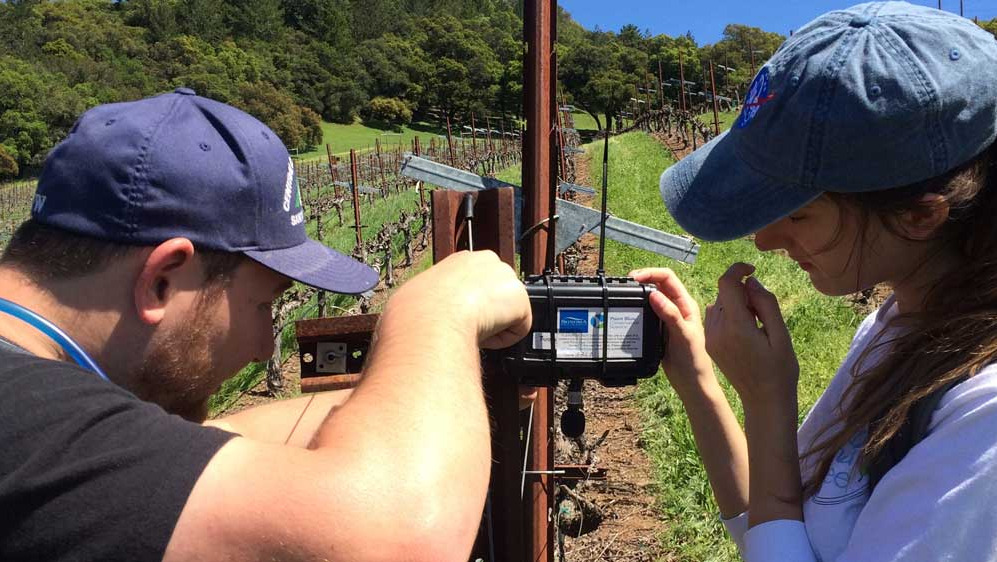
Soundscapes to Landscapes is a citizen science project that uses open-source hardware – including AudioMoth, a low-cost, full- spectrum acoustic sensor, developed by Open Acoustic Devices here in the UK – to map bird diversity across Sonoma County, California.
By comparing the research of citizen scientists with environmental data gathered by NASA, the Soundscapes to Landscapes project aims to advance the use of remote sensing satellites for monitoring, predicting, and conserving animal diversity on Earth.

“It is recognised that the data collected by citizen scientists can be much larger and even more accurate than by paying a team to do the work,” says Soundscapes to Landscapes project lead, Dr Matthew Clark, a professor at Sonoma State University.
Matthew and his team of volunteers capture ‘soundscape’ recordings at audible and ultrasonic frequencies, which are then used by experts within the birding community to identify bird species within a particular area.
These bird diversity maps make it possible to test the accuracy of models that use algorithms to predict the distribution of bird species based on environmental data gathered by NASA’s remote sensors.

351,692 MINUTES OF RECORDINGS
The data collected by these systems can be used to determine the physical structure of vegetation over vast areas, such as the heights of trees and plants, as well as the canopy chemistry, which can be used to assess ecosystem productivity and habitat quality.
“In my PhD research in the early 2000s, I explored these technologies in a wet tropical forest with the goal to map tree species and estimate forest structure and biomass. These were some of the first applications of these two types of sensors in tropical forests,” says Matthew.

To complete their prototype phase in 2017, Matthew and his team of local volunteers partnered with the Pepperwood Preserve, a 3200-acre site that acts as a refuge for over 750 species of plants and 150 species of wildlife in North California’s Mayacamas Mountains.
While at Pepperwood, they collected AudioMoth sound recordings from over a hundred different locations. The team also completed their species distribution modelling code in R (an open-source software and programming language commonly used for data analysis) and developed bird call identification models and species distribution probability maps for nine different species of bird.
ANIMAL BIODIVERSITY MONITORING
Initially, the project used Android smartphones to capture audio recordings but quickly switched to AudioMoth due to the hardware’s simplicity and low-cost per unit.
“We were thrilled with the ease of using AudioMoths,” says Matthew. “We have also found the sound fidelity is much better than with the smartphone, which was designed to record human conversations, not environmental sounds.”
Following success in Pepperwood and surrounding areas, Soundscapes to Landscapes received funding from NASA’s Citizen Science for Earth Systems Program (CSESP), which put the project on track to map all of Sonoma County, a vast area of over 1760 square miles, by 2021.
Since the beginning of March this year, student interns and community volunteers have already collected recordings from more than a hundred sites, totalling over 175,000 minutes of audio.
“We could not have had this productivity if it was not for the energy and passion of our new project coordinator, Rose Snyder, based at Point Blue Conservation Science,” says Matthew.
“Our team worked with Rose to create a whole new process for managing citizen scientists into teams, tracking AudioMoths, organising sound recordings, and identifying properties to visit.”
Matthew believes that there is still work to do in regards to providing NASA-funded citizen science projects with more detailed guidelines on how to promote and run projects with the general public.
“We worked with Sieve Analytics to create a new Citizen Science interface to ARBIMON,” he says. “This will allow us to find soundscapes with potential bird calls. Citizen scientists can then quickly validate if the bird call is really present or not.”

Once that data is validated and labelled, it is passed to a research team at the University of California that is using deep learning to identify bird calls. “We are currently working on having a single convolutional neural network classifier that will identify 32 bird species in all of our recordings… currently 350,000 minutes in total,” says Matthew.
Despite the project’s growing support, there are still many areas of Sonoma County that are difficult for the team to access. “In the next field season, we will be stepping up our effort to mail out flyers to targeted property owners in these areas, and hope to send recorders out to these landowners for deployments on their properties,” Matthew explains.
To find out more about the Soundscapes to Landscapes project and get involved in next year’s field season, visit soundscapes2landscapes.org
AudioMoth is a low-cost, open- source, full-spectrum acoustic sensor capable of recording uncompressed audio to a microSD card for environmental and biodiversity monitoring in remote habitats.
The full article with more information about AudioMoth is in issue 22 (pages 58-61).

Cameron is a technology and communications specialist, passionate about the use of open-source hardware for social innovation
Subscribe to Raspberry Pi Official Magazine
Save up to 37% off the cover price and get a FREE Raspberry Pi Pico 2 W with a subscription to Raspberry Pi Official Magazine.
More articles
Raspberry Pi Official Annual 2027 is out now!
New name, same fantastic content
Read more →
Robot arm lamp
This won’t be jumping on any animation studio logos
Read more →

Sage Cadence interview
An electrical engineering student trying to provide the educational content she would have wanted
Read more →