Strato Pi CM Duo review
By Lucy Hattersley. Posted
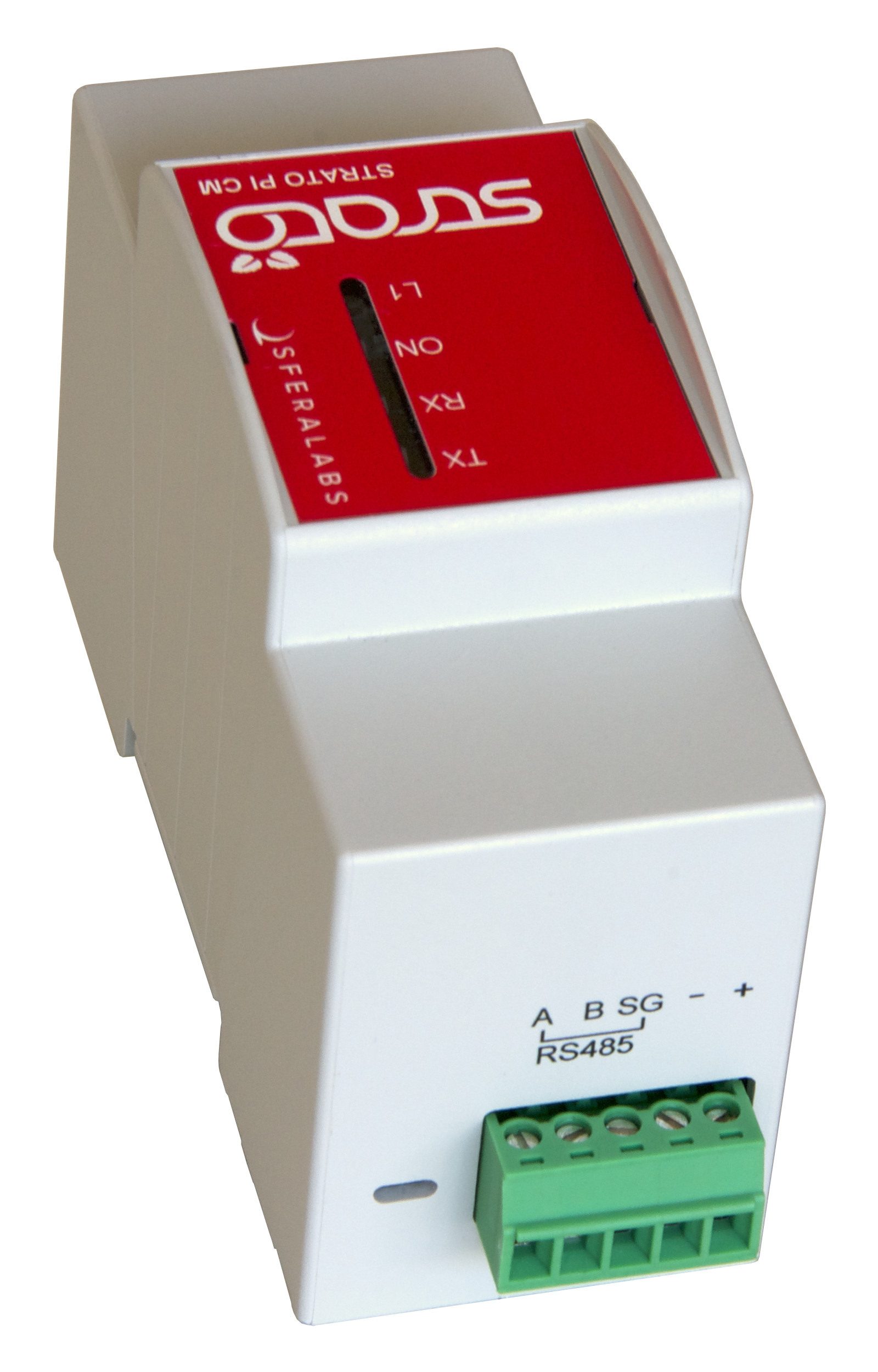
Strato Pi CM Duo is an industrial server comprising a Raspberry Pi Compute Module 3+ inside a DIN-rail case with a slew of additional features. Not least of which is the presence of two microSD card slots (hence the ‘Duo’ moniker).
As a quick reminder, a Compute Module is the innards of a Raspberry Pi 3 computer integrated onto a small (67.6 × 31 mm) board that plugs into a standard DDR2 SODIMM connector.
Strato Pi takes this stripped-down Raspberry Pi and uses the DDR2 SODIMM connector to hook it up to a custom board with 10/100 Ethernet, two USB Type-A ports (with individual power and fault detection), a real-time clock and CR1025 battery, and a hardware watchdog chip (used to switch between the two microSD cards and perform a hardware reset if required).
A green plastic terminal block has five positions for power and serial connections. It’s rated 9–28 volts with surge protection (and delivers 1.9 A at 5 V to the Compute Module). The Strato Pi takes over most of the GPIO pins, but uses the standard UART TX/RX pins on the GPIO connector to implement a standard RS-485 port. The RS-485 interface can be used to integrate the Strato Pi with a range of industrial control systems and communication signals. It can handle up to 32 devices, at a range of up to 1200 metres.
Uptime
Our device shipped with stock Raspbian, and we removed one of the microSD cards and added a blank ssh file to the boot system to gain access (don’t forget to change the password). From there you can install the Strato Pi utility software, install the real-time clock software, and control the RS-485 serial port. Detailed instructions are in the user guide.
The two microSD card slots are hidden inside the case (away from prying fingers) and you can switch between the two. You can run one as a boot drive, and the second as storage; but the primary use-case is to maintain uptime during any upgrade process.
Verdict
8/10
Strato Pi CM Duo is an excellent piece of kit. We found it to be well-built, with an intelligent design that integrates Raspberry Pi with the industrial landscape. It’s not a low-cost solution, but then neither is industrial downtime.

Lucy is Editor of Raspberry Pi Official Magazine.
Subscribe to Raspberry Pi Official Magazine
Save up to 37% off the cover price and get a FREE Raspberry Pi Pico 2 W with a subscription to Raspberry Pi Official Magazine.
More articles
Raspberry Pi Official Annual 2027 is out now!
New name, same fantastic content
Read more →
Robot arm lamp
This won’t be jumping on any animation studio logos
Read more →

Sage Cadence interview
An electrical engineering student trying to provide the educational content she would have wanted
Read more →